MacGyver Season 2 Episode 21 Science Notes: Wind + Water

Ignite gas with a pay phone.

In order to escape from a dinner, MacGyver opens all the gas outlets in the kitchen to fill the building with gas. He then takes apart a pay phone and disconnects the ringer. Super old pay phones (what’s a pay phone?) have a mechanical oscillator that rings a bell.

Can you use this to make a spark? Oh, yeah. In fact, I used a very similar in a version of my spark gap generator radio transmitter.

Boom crane with a ladder

In order to get some heavy pieces on top of a house (to rebuild the roof), MacGyver uses a rope running over a movable ladder to act as a type of crane. I thought I had a pre-show sketch of this, but I couldn’t find it.

Fixing a flat tire

The truck has a flat tire. MacGyver needs to do two things—plug the hole and fill the tire. To plug the hole, he uses a bit of rubber and heats it up. Then you just push this through the hole in the tire. That’s it. Honestly, I have done this with an actual flat tire and I was surprised that it worked.

For the air, MacGyver connects the tire of the scooter to the truck. Yes, this would add some air to the truck tire from the scooter tire—but only until the two tires reach the same pressure. That might plausibly be enough air to get you going, but likely not.

If you want to get more air from the scooter tire, you could heat it up. When the air in the scooter tire increases in temperature, it increases in pressure. You need the scooter tire pressure higher than the truck tire to get a transfer.

Black pepper on a gunshot wound

One of MacGyver’s friends gets shot in a bank. MacGyver needs to stop the bleeding. Oh, here is some black pepper. Yup, that seems like it would work. https://knowledgeweighsnothing.com/how-to-stop-bleeding-with-black-pepper/

DIY radio

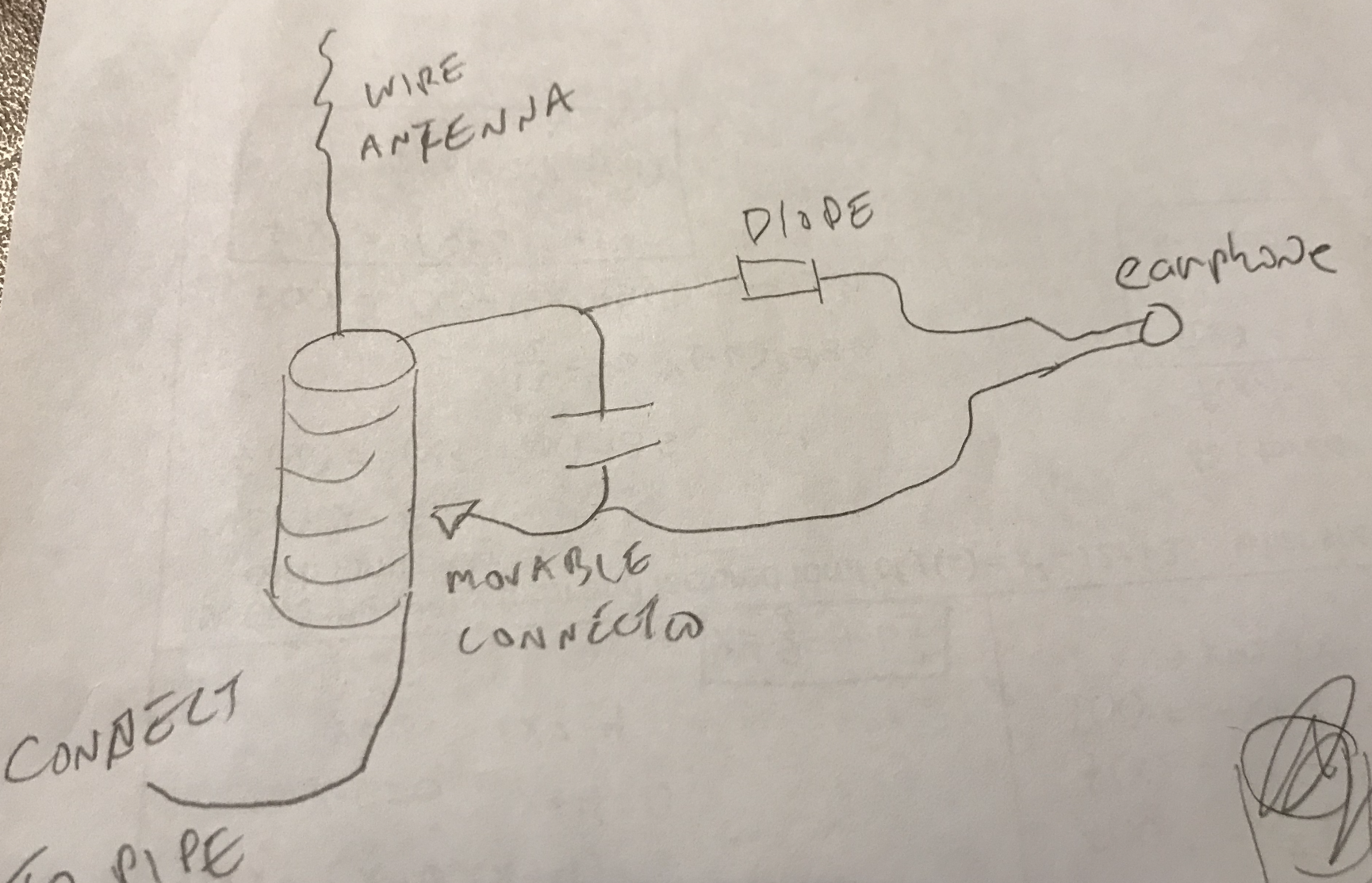
A basic radio really isn’t all that complicated. You need a capacitor, a coil of wire (for the inductor) and some type of diode. Soldiers used to make them from scratch on the front line in WWII—they were called foxhole radios.

Here’s a more detailed post about this simple radio—https://www.wired.com/2016/05/go-ahead-connect-inductor-capacitor-see-happens/

Ok, but what if you want a two way radio? Yup, it’s much more difficult to transmit. But still, you get the idea. Here is a sketch from the show notes.
Dye pack explosion

So these banks have these exploding packs of dye. That way they can toss them in with some money when bad guys steal stuff. Some of the packs are radio activated, but others go off (after a delay) when passing out of the main bank area. https://en.wikipedia.org/wiki/Dye_pack

MacGyver just puts one in a coffee cup and tosses it past the door. Since it makes a noise, the baddie goes to investigate and BOOM. Ink in the face.

Ethernet rope ladder

MacGyver makes a rope ladder out of ethernet cable so that people can escape from a second story window. It might take a while to make, but this is fairly legit.

Bomb thingy

I honestly can’t remember the exact kind of bomb MacGyver is making here—and that’s fine because I wouldn’t tell you anyway. But he uses some stuff from the bank to get into the sewers below.

Falling telephone pole

For the last hack, MacGyver hits a telephone pole that’s ready to fall over anyway. The pole falls and lands on the bad guys car. The end.

MacGyver Season 2 Episode 20 Science Notes: Skyscraper + Power

DIY torch

Hand sanitizer is mostly ethyl alcohol—it burns fairly nicely. Oh, but don’t play with fire. If you put this stuff on a roll of paper towels, it should make a great torch. It would probably have more of a blue color though.

Actually, you can just squirt some hand sanitizer on a cement floor and light it on fire.

WiFi Radar

This is a “Riley hack”. Since the power is out in the building, she hacks into the wifi routers for the nearby buildings. By looking at the strength of the wifi signals that go through the building, she can sort of judge where people are moving.

Oh, this is crazy? No, this is based on some real stuff.

https://gizmodo.com/scientists-are-turning-wifi-routers-into-creepy-radar-c-1794961990

DIY Glow stick

That glow stick that you use for Halloween is just a mixture of two chemicals. In that particular chemical reaction, it is an example of chemiluminescent—a chemical reaction that produces light. It’s sort of cool.

It’s not perfect, but it is possible to make your own glowstick.

Elevator descender

You can’t really see exactly what MacGyver has rigged up—but it’s a type of descender. The basic idea is that when a torque is applied to a ring around a line, it binds up with a frictional force to prevent it from sliding.

Here is a diagram I created that might help explain how this would work.

Inline image 1

These two loops around the elevator cable could be just about anything. One idea was to use some padlocks—but as long as it’s stiff and goes around the cable, that’s fine.

So, here’s how it works.

  • If MacGyver puts his weight on the bottom element, it will provide a torque and bind up against the cable.
  • He can then move the top element down.
  • Next, he hang from the top element so it binds and then he can move the bottom thing.
  • Repeat

DIY Tesla coil

A Tesla coil is essentially a device to create a very large electric potential difference (many would say high voltage). The most common method is to use a series of transformers—a way to convert AC signals to higher voltage (yes, I said it).

For MacGyver’s hack, he uses the ballast from a bunch of fluorescent lights. A fluorescent light starts with a tube of gas. Electrons are accelerated in this tube and interact with the gas molecules to produce light. This light is in the ultraviolet range, so you really can’t see it. But there is a coating on the inside of the tube that absorbs the UV and produces white light—this is the “fluorescence” part of a fluorescent light.

But the key is high voltage. Yes, the electrons need to be accelerated over an electric potential difference that is greater than the usual 120 volts from your AC outlet. That’s where the ballast comes into play. This takes the 120 volts from your household circuit and ramps it up to something like 500 volts.

What about a Tesla coil? If you want to get cool (and giant) sparks, you will need about 5,000-30,000 volts. So, would 10 ballasts do the trick? Probably not—the voltages just don’t add up that way. But still, it’s based on a real thing.

Faraday cage

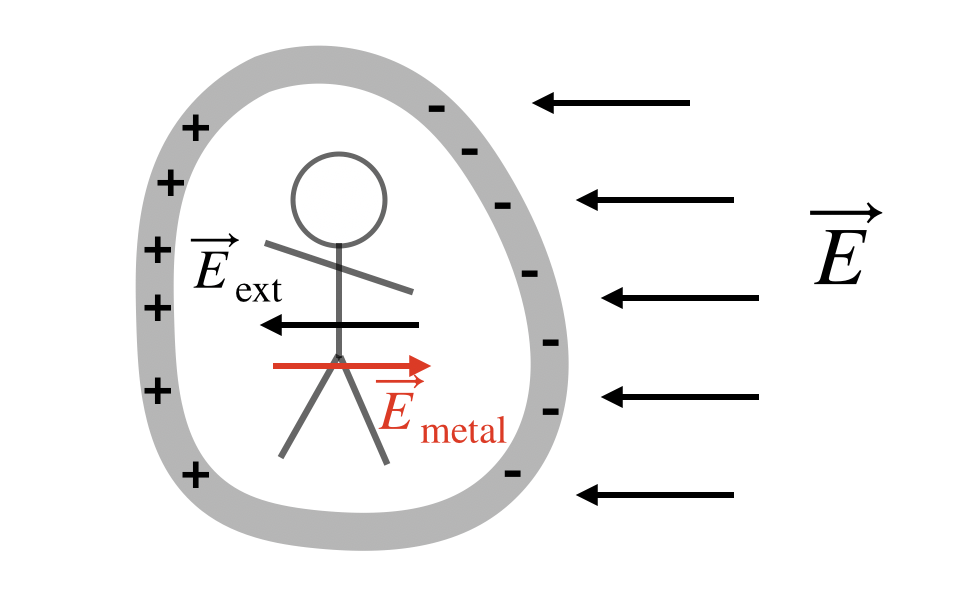
You can’t “block” electric fields that are associated with things like sparks and electromagnetic waves—but you can make more electric fields that produce a zero electric field. That’s what a Faraday cage does. It creates more electric fields that cancel an external electric field.

Here is a very basic example. Suppose I have a constant electric field and I want to “block” this. If I put a piece of metal around me, the external electric field will move charges in the metal and these charges will create more electric fields. When you add all the fields up, you get a zero field—it’s just like the field is canceled.

The cool part about a Faraday cage is that it doesn’t even have to be solid metal. You can still have holes in it and it will cancel electric fields. Here is an example of a Faraday cage with a radio and some aluminum foil.

MacGyver Season 2 Episode 19 Science Notes: Benjamin Franklin + Grey Duffle

Homemade Balloon Float

This is just the beginning of the show, so we don’t really know what’s going on except that Riley, Jack and MacGyver are on a trampoline supported by a bunch of balloons.

So, I will just leave this as a homework question for you. How many balloons would you need to lift 3 humans?

Resonance

Pinned down by gunfire, MacGyver needs a way to distract the baddies so that they can make their move. Angus takes his phone and plugs into an audio sound system and plays some high pitched song. This is the classic demo of singing to break some glass. Of course, that doesn’t usually involve a glass window—but still this is all about resonance.

If you go out to a playground, you can find a nice swing. If you push the swing at regular intervals, you can get the swing amplitude to increase. But here is the key point. The frequency of the pushes has to be the same as the natural oscillation frequency of the swing. Otherwise, your push might be timed at the bottom of the swinging motion which could cause the thing to slow down.

If you want to break glass with sound, it is indeed possible. Here’s what you do. Take some glass and give it a nice little tap so that it makes a ringing tone. Measure the frequency of this ring and then play that same frequency with a speaker—it’s got to be LOUD for it to work.

Of course loud noises and breaking glasses aren’t always safe. Here is an alternative demonstration with resonance. As a bonus, you can use this as a magic trick for your friends.

Detecting counterfeit money

They have all these 100 dollar bills. The suspicion is that they are fake—they are one dollar bills reprinted to be 100s. MacGyver puts them in an acid solution to dissolve the new ink as a test.

GPS phone tracker

MacGyver takes the gps receiver along with a battery from a phone and creates a tracking device. Of course the gps is actually built into the processor for most phones—so let’s just say he takes that whole thing (along with the LTE transmitter). Yeah, this would basically work.

Duffle bag battering ram

There is a duffle bag filled with cash. MacGyver hangs this up and uses it as a type of battering ram—to knock over a bad guy.

Bonus Homework

When MacGyver brings in the counterfeit money, he says:

“Yeah, well one million dollars in 100 dollar bills is actually only 20 pounds…so…”

OK—go. Check if this quote is legit. Here is some help. This is a post to estimate the size of a stack that contains 1 trillion dollars. I also use this as an opportunity to calculate the density for a dollar bill. https://www.wired.com/2011/09/stacking-one-trillion-dollars/

MacGyver Season 2 Episode 18 Science Notes: Riley + Airplane

Carpet body restraint

There’s really not too much to explain here. MacGyver rolls a guy up in a carpet and uses that to keep him in place. Seems like this should work.

Reminder—even though there’s not any great science to talk about here, I love these kinds of hacks.

Pick a lock with an antenna

MacGyver pulls a metal antenna off a motorcycle and then uses it to pick the lock on the same motorcycle. Oh, this is a police motorcycle—he uses it to turn on the siren.

Is this possible? Possible, yes. Normally you need two things to pick a lock—something to move the lock pins and something to provide torque. Theoretically, you could do it with one—but it would be tough.

Radiator fire extinguisher

There’s a car on fire and they need to get something out of it. MacGyver improvises a DIY fire extinguisher by using the cooling system of another car. He grabs a pipe and then pokes a hole in the radiator. When the engine is revved up, the coolant shoots out through the pipe and onto the burning car.

Again, the theory here is solid. You could probably even get the coolant to shoot fairly far. However, it would take a significant amount of coolant to put out a fire.

Statue battering ram

This one is good. MacGyver and Jack take a marble statue and support it from some rope and stuff such that it can swing. Then they swing this statue into a door. Boom—battering ram.

Hacking airplane wifi

OK, not hacking to get free wifi but using the wifi to control the whole plane. That’s what Riley does as she is stuck on a plane with a virus. Is this even possible?

Sadly, this might be true. Check this out. https://www.wired.com/2015/05/possible-passengers-hack-commercial-aircraft/

MacGyver Season 2 Episode 17 Science Notes: Bear Trap + Mob Boss

Radioactive Stuff

This is not a MacGyver-hack. But he is talking about radioactive stuff. Here is my super short explanation.

An atom is made of a positive nucleus plus some electrons. Normally, there will be the same number of electrons as protons in the nucleus. This makes the overall charge of the atom zero. But wait! There are also neutrons in the nucleus. Let’s just look at an example.

Strontium-90 is an atom with 38 protons and 38 electrons. It also has 52 neutrons in the nucleus—oh, and it’s radioactive. Strontium-88 also has 38 protons and electrons, but it only has 50 neutrons. Since these two atoms have the same number of protons, but different neutrons—they are isotopes of each other.

Sr-90 is radioactive. That means its nucleus is unstable. It goes through radioactive decay and produces Yttiruim-90 which has 39 protons. So, one of the neutrons in Sr-90 turns into a proton and also produces an electron (so that charge is conserved).

The half-life of Sr-90 is 28.8 years. Since the decay process is random, there are more decays when you have more atoms. This means that the decay rate depends on the number of atoms. So, you can’t say how long it will take for all the material to go through radioactive decay. Instead, we say how long it will take for half of it to decay—that is the half life.

So, does that mean that all of the material will decay in 2 times 28.8 years? Nope. It means that after 28.8 years, you will have half as much stuff. After another 28.8 years you will again have half of what you started with. Every 28.8 years, you will have half as much.

What about Plutonium? There are several different isotopes. Plutonium-238 has a half-life of 87.7 years. Plutonium-239 has a half life of 24,000 years. The shorter the half-life, the more “radioactive” it is. But for longer half-life stuff, it’s still going to stick around for a long time.

DIY Geiger Counter

A Geiger counter is a device to measure radioactivity. It consists of an outer conducting tube with a conducting wire running down the middle. The wire and tube are at different electric potentials—usually a fairly high voltage.

When a charged particle (the result of a radioactive decay) enters the tube, it interacts with the gas molecules to ionize them—knock out an electron. This free electron then accelerates in the high potential and collides with other gas molecules to produce even more free charges. More and more charges are produced—it’s called an electron avalanche. This avalanche is then detected as an electron current—usually to produce an audible click. That’s the clicking sound you hear.

Here is MacGyver’s build.

He uses a motorcycle muffler as the tube—you can’t see the wire in the middle, but it’s there. The battery provides the voltage and then there is an audio speaker to convert the electron avalanche into sound.

Oh, I forgot—here is a video demo.

Bonus. Here is my sketch for the DIY Geiger counter.

DIY Ice Climbing Gear

There’s really not much to explain here. MacGyver uses some cut up chain link fence and some rebar to make spike-shoes and a type of ice pick. He uses these to climb up an old brick wall—sticking the metal into the old mortar. It seems like it would work.

Disabling Trucks

MacGyver builds one of those rolling things that mechanics use to get under cars (I forget the name). With that, he disables the trucks (all but one). Really, once he is under the truck he could do a number of things. He could cut the fuel line or cut an electrical line—let’s just say he does it.

Simulated Radioactivity

In order to convince the mob that the key guy they are trying to catch isn’t worth it. They make it look like he is super radioactive. The mob guys have a Geiger counter—so MacGyver needs to remotely set that off.

My original idea was to have him build an electron gun—like this https://www.instructables.com/id/DIY-Electron-Accelerator-A-Cathode-Ray-Tube-in-a-/

The electron gun would shoot electrons into the Geiger counter and set off an electron avalanche in the same way that a radioactive source would. Unfortunately, it was too complicated of a build.

What about a super high amplitude electromagnetic wave? The idea is that when the electric field part of the wave hits the detector, it will increase the field inside and make it more sensitive to ionizing radiation. This would make it seem like something is more radioactive than it is. Yes, I know this is a stretch—but it’s based on some real idea.

Here’s how he could build it.

  • Start with a radio – it has to be a transmitting radio.  Maybe a CB, maybe a portable radio?
  • Boost the power to the radio.  I think plausibly connect the power source from the radio to the 12 volt car battery?  
  • Get a bent piece of metal to put around the radio antenna to make a focusing dish.  Alternatively, you could find some pre-existing dish- aim the dish-radio at the Geiger counters.  boom.

MacGyver Season 2 Episode 16 Science Notes: Hammock + Balcony

Sorry for the delay in science notes. There were things that got in the way.

Block and Tackle

I don’t really like calling it that. A better term is a compound pulley. But the key to all of the simple machines is force vs. distance. If you increase the distance over which you apply a force, you can get a larger force output of the machine over a shorter distance. That’s exactly what happens with a “block and tackle”.

Here is a more detailed post about compound pulleys. https://www.wired.com/2017/01/physics-of-a-compound-pulley/

If you want to see a DIY pulley from an earlier MacGyver episode, here you go:

Drinking Without Getting Drunk

This one is pretty good. Yes, you can drink without getting drunk. Check this out (actually, don’t read it because you don’t have access) —https://www.nature.com/articles/nnano.2012.264

But basically it’s alcohol oxidase with some other stuff added. When mixed with alcohol, this makes aceteldehyde—the main thing that causes hangovers. MacGyver could get alcohol oxidase from alcohol test kits.

Note: I’m not a biochemist, I got this info from my brother (a biochemist).

DIY Chloroform

Don’t make this stuff. But it is possible. Actually, I’m not even going to include the link.

Mechanical Stuff

Using a hammock as both a ladder and a body sling? Yup, that’s good. Using a chain as a DIY car boot. That works too. Not much to explain, but I think both of those hacks are great.

Chloroform Bomb

In order to knock out everyone in the room (including himself), MacGyver throws some chloroform in a container into a fire. It explodes and everyone gets knocked out. Sure, this would be tough to do in real life—but it’s a least plausible.

DIY Arc Lamp

Wait. There wasn’t an arc lamp in this episode was there? Nope. It get cut out of the beginning. However, I made an arc lamp anyway as part of my DIY videos. It’s awesome.

MacGyver Season 2 Episode 15 Science Notes: Murdoc + Handcuffs

Non-science note. The more I see David Dastmalchian as he plays Murdoc, the more impressed I am. That dude is awesome. Also, this episode has a great “Midnight Run” type of feel (great movie, btw).

Now for some science stuff.

Portable Gas Chromatagraph

This part of the script is pretty nice:

Jack: “You brought something too?”

MacGyver: “It is a portable gas chromatograph. So, It takes samples from the air and it scans them for explosive particular matter.”

Jack: “So, it’s a bomb detector? Why didn’t you say that?”

MacGyver: “I thought I did.”

Perfect.

A gas chromatograph is sort of complicated. But yes, it could be used to detect chemicals. Yes, you can make them portable. That’s enough.

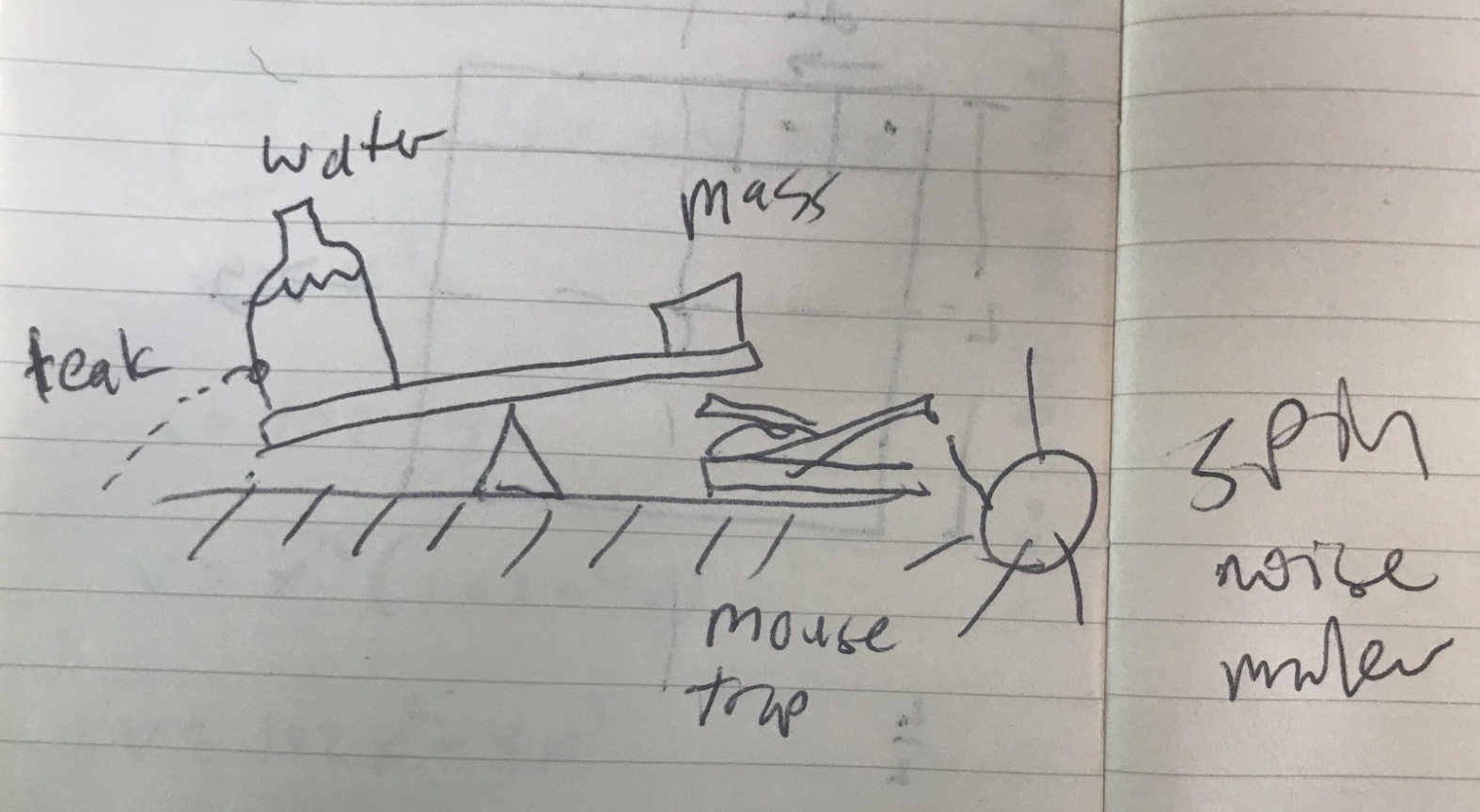
DIY Noise Maker

How do you get the attention of a bad guy? House about a noise maker? This is essentially the same as this mouse-trap powered car. https://www.wikihow.com/Build-a-Mousetrap-Car —but instead of a spinning wheel, it

Oh, it has a built in timer—a leaking bottle of water. Here is the shot from the show.

And here is my rough sketch.

Speaker Microphone

Oh snap. That pay phone is broken. Wait! What’s a pay phone?

MacGyver fixes the missing headset by using two speakers from the car. One speaker is used for the speaker and the other speaker is used for the microphone.

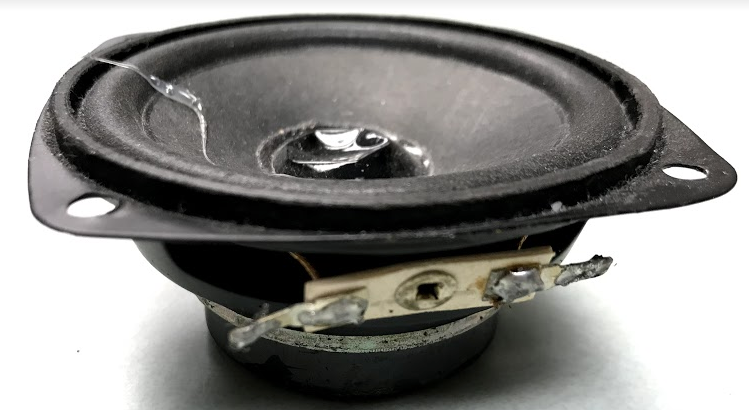
It’s actually pretty cool, but most speakers can be used a microphone. The normal speaker is basically just three parts:

  • A magnet.
  • A coil of wire.
  • Some type of surface area to push air.

The coil of wire is connected to the speaker surface. When current is run through the wire, the coil makes a magnetic field. This magnetic field from the coil interacts with the other magnet to either push or pull the surface of the speaker. This in turn pushes the air into compressions—and it is these compressions in the air that make the sound.

For a microphone, the reverse happens. Compressions in the air push the surface. This moves the coil closer (or farther) from the magnet. This motion changes the magnetic flux (via Faraday’s Law) which induces a current in the coil. This current is then recorded as an audio signal.

Don’t believe me? You should try it. Oh, make sure you use a speaker like this:

OK, there are some weird things in these old phone head sets. I think they have to use super low resistance microphones and speakers since the power comes over the phone line. But still, this is very plausible.

Break a chain with handcuffs

Oh, and a steel rebar thing. MacGyver loops the handcuffs around the chain and then puts the rebar through the cuffs and twists.

With a longer metal bar, you can get a high torque on the chain. This should break the chain—at least as long as the hand cuffs are stronger than the chain.

MacGyver Season 2 Episode 14 Science Notes: Mardi Gras Beads + Chair

Breaking and Entering Through a Window

Don’t break into people’s houses. Oh sure, there are lots of ways to get into someone’s house. Think of a locked door as a social norm. People agree to not go past that locked door (or window)—even though they probably could.

In this case, MacGyver gets in through a window. In some cases, it’s possible to use the friction between your hands and the glass to shake the window up and down. This can slowly force the window lock into the unlocked position.

Detecting Metallic Ink

Here is another one that seems crazy, but it turns out to be not so crazy. MacGyver builds a detector to find some hidden cash. Yes, it’s indeed possible to detect the change in magnetic fields due to metallic ink in US currency.

https://www.newscientist.com/article/mg21328576-100-metal-detector-knows-how-much-cash-is-in-your-wallet/

But you have to be pretty close—and really it would only work to determine how many bills are in a container. However, there’s still a chance this could work.

In this case, MacGyver uses a hall effect sensor along with a speaker to create an audio-based system to search for the money. In the show it works like a metal detector—but it’s not a metal detector since the hall effect probe detects magnetic fields.

I’m not sure I should go over all the details of a hall effect sensor, instead I will just like to one of my WIRED posts on the subject.

https://www.wired.com/2014/01/measure-magnetic-field/

But what about the speaker part of this build? Well, it is indeed true that you get a voltage signal out of a hall effect probe. If you run this into an audio amplifier, you probably won’t get any sound because you would need a changing magnetic field. But it seems likely that you could have the hall effect probe voltage control and audio tone.

Anyway, here is my very basic sketch for this detector.

Distraction with Streetcar Sparks

MacGyver grabs a chain and throws it onto the wire that the streetcar runs on. Sparks fly and cause a distraction.

The New Orleans streetcars are electric powered trains. They get power from two lines. There is a line above the car and the other is in the rails (at least I’m fairly sure that’s how it works). So, just touching a wire at the top with a conductor wouldn’t do anything. If you had a chain running from the top wire down to the ground, that would cause a short circuit and probably melt the chain. It would be bad.

Of course there is a way to get this to work. What if MacGyver throws the chain over the power line so that the chain hits both a power line AND a support pole? I imagine there is an insulator keeping the power line isolated from the ground, but getting that chain to make a connection would do the trick.

Infrared Chemical Tracker

MacGyver finds the following stuff:

  • Muriatic acid
  • Selenium powder (they make solar panels with this stuff)
  • Cadmium oxide – the stuff from the inner part of a battery

With this he is making a type of quantum dots.

Oh, I forgot to say something—quantum dot tracking dyes are real.

https://www.newscientist.com/article/mg21929315-100-drones-tag-and-track-quarry-using-nanoparticle-sprays/

The idea of the quantum dot is that it is a very small particle that emits a particular frequency of light. If you “excite” it with an ultraviolet laser, it can emit infrared radiation that can be detected with a drone camera. Cool.

So, for MacGyver’s case—they skipped the whole UV light part. But still, this is another great example of something that seems crazy but is in fact based on some real science. Science is crazy.

MacGyver Season 2 Episode 13 Science Notes: CO2 Sensor + Tree Branch

Let’s pause for a moment and review some things.

MacGyver is a show. It’s fictional. It’s not real. Some of the things are BASED on real science (and some of them are legitimately real). But it’s still a show. It’s like Star Wars—but without the light sabers. Everyone knows there is no way you could even THINK of making a lightsaber with science, but we like them anyway.

So, even though some of the hacks in the show are only slightly plausible, there is still an element of truth in there somewhere. Honestly, I’m just happy that anyone even cares to make a show that even considers real science. Thanks Peter!

OK, now for this episode’s MacGyver hacks.

Tracking a vehicle with CO2 sensors

So, there’s this runaway robot car with guns and the Phoenix team has to find it. It’s got stealth technology, so they can’t find it from above. That leaves MacGyver, Riley, and another girl in a car to track it down.

The idea is to use the carbon dioxide emitted from the robot. Yes, it’s a hybrid vehicle. That means it has an internal combustion engine. These things take in gasoline and produce energy along with carbon dioxide and other stuff. Oh, it’s this same carbon dioxide that contributes to global warming and climate change—just to be clear.

MacGyver grabs a CO2 sensor out of the car’s AC unit. Some more modern vehicles include a carbon monoxide detector to prevent passengers from getting poisoned. Some auto makers even have CO2 sensors—it’s true. https://www.co2meter.com/blogs/news/23987521-high-co2-levels-in-your-car

The plan is to have two CO2 sensor sticking out of the car on tree branches (now you get the title). The sensors are connected to the dome light in the car so that they can tell which direction has a stronger CO2 and then they know which way to turn.

Here’s what it looked like.

Here is one of my diagrams (this went through quite a few iterations).

Here is one of my earlier diagrams—it was slightly more realistic using some MOSFETs for amplification and everything.

In the end, the CO2 level in the air from a vehicle is quite small. I think it would be seriously implausible to use two detectors to determine the direction to the robot. So, I will go ahead and give this is “real score” of maybe 1.5 out of 10. Here are some other hack scores—in case you are curious.

Stopping Brutus with a Sat Dish

I forgot to mention that the robot-car’s name is Brutus. MacGyver plans to stop Brutus with a radio frequency car killer. These things are real. https://www.dailymail.co.uk/sciencetech/article-2518177/RF-Safe-Stop-disables-vehicles-engine-remotely-using-radio-beams.html

The basic idea is to beam high power radio waves at a vehicle to fry the electronics. In this case they say it just drowns out the network so that Brutus can’t communicate and it stops.

MacGyver builds this RF gun using a transmitter on the truck and a satellite TV dish. In order to get the power high enough, he uses the car battery.

OK, now for a homework question. Assuming the van they are in has a normal style car battery, how much current does the RF gun use so that it drains the battery in 5 minutes? Some estimations might be required.

Hotwire a car

I’m pretty sure I talked about this in a previous post. Modern cars are really tough to hotwire—good thing they found an older camero.

Lever

Final hack of the show. MacGyver uses his phone and a belt to pull and bend the vents on Brutus. He needs a space big enough to fit a USB stick through. It’s funny because MacGyver kills his own phone and not Jack’s.

MacGyver Season 2 Episode 12 Science Notes: Jack + Mac

Before I get to this science for this episode (there’s some great MacGyver hacks here), let me say something else about the show. The storyline for this episode was great. It had a nice plot, and I really enjoyed the MacGyver and Jack flashbacks. Now for some science.

Photophone

The best Mac-hacks are real. This is real—very real. It is indeed true that this was an early idea for a phone. Here’s how it works.

  • You need a directed light. One way to do this is to get a mirror that reflects sunlight. A parabolic mirror works a little better, but still the mirror is a great idea.
  • Use your voice to shake this mirror. This changes the intensity of the reflected light to match the wave pattern of your voice.
  • Use some type of electrical photo device (solar panel, photo diode, photo resistor) to modulate an electric current to this same sound pattern from the light. Send this to a speaker.
  • That’s it.

For MacGyver’s build, he uses a microphone and connects it to a porch light. The idea is that the microphone will modulate the brightness of the bulb. For this to work, I think it has to be an LED bulb. An incandescent won’t work (I don’t think) since the hot bulb filament won’t change brightness quickly enough for sound frequencies.

There is also the problem of AC vs. DC. If MacGyver connects to the AC power line going to the bulb, this might not work. But still—it’s very plausible.

On the other end of the photophone, Riley uses a police car light as her transmitter. Again, if this is LED it should work (plus the car runs on DC, not AC). Finally, the only problem is aiming. In practice, you need your detector to pick up the changing brightness from that one light. Of course it’s daytime, so there are many “lights” outside. Putting a lens on the detector to aim it would help a bunch.

OK, now you want to build one of these yourself. You should. It’s actually not too terribly difficult. Let’s start with the simplest part—the receiver. The easiest way to get this to work is to connect a small solar panel to an amplified speaker.

Oh, do you know where I got that solar panel? Yes, it was from a garden light. You put these small lights outside and the solar panel charges a battery during the day and the light comes on at night. They were old and the battery was bad, so I took it apart.

Now for the transmitting side of the photophone. I tried to do this with a laser instead of a light (so that I could aim it). It mostly worked, but it’s a bit more tricky.

This is something I need to rebuild at some point in the future. Make it better. But still, this should be in my list of Top 10 MacGyver Hacks. I need to make that list.

Gum Wrapper and Battery to Start a Fire

Ok, actually this was to melt a wire. MacGyver takes a foil gum wrapper and connects it to two ends of a battery. The idea is that the foil will make a short circuit.

But there are two questions:

  • Is a gum wrapper an electrical conductor? I don’t think they are actually made from aluminum foil—but I suspect that many of these do in fact conduct.
  • Would it get hot? Even with a small battery, yes I think it would.

DIY Non-Contact Voltage Probe

MacGyver needs to find wires behind the wall. He puts together this awesome looking probe (or as Jack calls it—a doohicky)

Actually, this prop is great. Here’s why.

  • It looks cool and it’s clearly a combination of multiple items.
  • It’s not specific—it doesn’t show exactly what MacGyver uses. This is good because that way it could still be plausible.
  • Finally, it’s based on something real.

But how does it work? There are multiple ways to detect voltages without touching—I think the most common method measures a super tiny voltage that is created by nearby electric fields. The NCVP is essentially part of a capacitor. When in the presence of an electric field, there is a voltage across the capacitor and you detect this voltage. I need to build one of these—for fun. I’ve seen a very basic version somewhere.

Kitchen Chemistry to Detect Explosives

How do you detect explosives? MacGyver is correct that most explosives are based on nitrogen. If you measure the nitrogen, you can get an estimate of the type of explosive.

There are many things in the kitchen that can be used to detect chemicals. Here is one that you can do at home—it’s a chemical-based pH detector (to determine if something is acidic). The color of this cabbage juice will change color depending on the pH level of the material.

Here’s how to make it.

Laser-Based Wire Cutter

Here’s the problem. There are two bombs that need to be disarmed at the exact same time.

The idea is to use a laser that turns on two identical cutters at the same time. The first thing to use is a beam splitter. This takes a laser beam and breaks into two beams. I guess that’s fairly obvious from the name. Here is a video showing how that works.

For the cutter part, it uses a photocell as the “switch” to turn it on. Here is a rough diagram I created for this hack.

In the end, these two motors might not cut at the exact same speed. But it’s still a fairly fun MacGyver moment.