I am honestly not quite sure how many blog posts I have about Thanksgiving. It’s probably about 1 per year for 8 years. I’m going to guess it’s 8. Here goes my internet search.
This stands for Safe Quick Undercarriage Immobilization Device (SQUiD). How long did it take someone to come up with that acronym? Awesome job. MacGyver’s version consists of a chain type thingy. When a car passes over it, the chain hooks on to the axle and wraps up. This would stop the car.
OK, it would’t flip the car over. It would stop the front wheels and the car would skid to a stop. But doesn’t the flip look cool?
Actually, that’s a great physics question. How fast would a car have to travel such that a sudden stop would flip it over? That’s your homework.
Methanol fire
Yes. Methanol burns—and you can’t really see it.
Carbon Dioxide Putting Out Fire
Fire needs three things: fuel, heat (to start), and oxygen. If you take away the oxygen, you take away the fire. If you replace the air (which has 21 percent oxygen) with carbon dioxide, the fire goes out.
So, in this hack MacGyver uses some CO2 tanks to fight the methanol fire. Yes, an exploding tank would put this fire out. Oh, but it would also make it hard for a human to breathe. Better hold your breath.
Pick a lock with a knife
This is theoretically possible. If you stick something in the lock and use enough torque, it’s possible that the pins in the lock could break. But otherwise, you need to jiggle the pins.
Comeback Can.
Real. You can build one yourself. You should. Do it.
Chemical Detector
MacGyver puts a chemical detector on the comeback can. When it rolls down the hallway and back, he can check if it contacted explosive chemicals. This is very plausible—there are several ways you could make chemical detection paper.
Tarp Bomb Lift
MacGyver uses a tarp under a bomb with a rope over a rafter in the ceiling to lift a bomb. A couple of notes.
If the rope just goes over a rafter (no pulley), you would need as much weight pulling down as the weight of the bomb. Since two people are pulling, this is at least plausible.
Actually, there is a cool physics problem here. If Riley and Bozer pull at an angle, how much can they lift without sliding towards the bomb? Don’t do this as a homework problem, I’m going to do it.
This is really just for me so that I won’t forget. I mean, I will forget—but then I can look back at this post and remember stuff. Here’s to you Future Rhett.
But this isn’t the best system. The problem is that there are two coordinates—the angle for the top bar and the angle for the bottom bar. Sure, it’s cool—but what if you want to plot angle vs. time or something. You have to plot both angles vs. time and that’s a bummer.
OK, how about a model of bounded population growth? That’s just one dimensional, right? Actually, it doesn’t even have to be population, it’s just an equation—something like this.
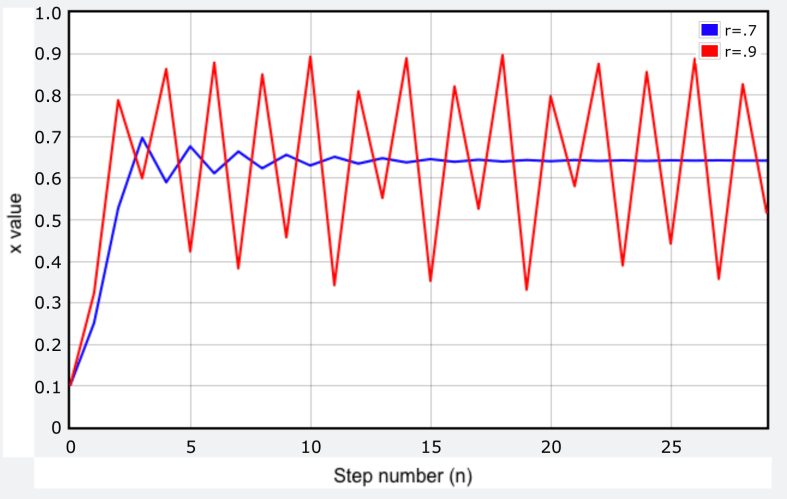
In this expression, r is some parameter—it really doesn’t matter what. Let’s just model this expression for different values of r. I’ll use a starting x value of 0.1 and r values of 0.7 and 0.9. Here is the code.
Notice that when r = 0.7, the population reaches some stable value—but this is not true for r = 0.9.
Bifurcation Diagram
Now for another way to look at a chaotic systems—the bifurcation diagram. Honestly, I didn’t really understand these things until I made one. Here’s what we are going to do.
Start with some initial value of x (just pick something—I’m going to use 0.5). Pick a value for r also. Let’s just start at 0.1.
Run the model for 200 iterations and throw out that data. This should allow us to look at the long term behavior for that particular value of r (throws out the transient behavior).
Now run the model for 100 additional iterations and save these.
Create a plot of these final x values vs. r.
Next increase the r value a little bit (I will increase it by 0.001)
Repeat until you get bored.
So if the model is stable after the initial stuff, then it will just keep plotting the same value of x after the first 200 iterations and you will just get a dot. If it’s not stable after the first stuff, then you will get a bunch of dots with different x values.
OK, let’s do it. Here is the code. Oh, I made a function to iterate the model. I probably should put more comments in there.
This is what it looks like.
Up to an r value of about 0.75, you only get one final x value. After that, you get two different values . With r over 0.9, it gets crazy.
OK, that’s enough for now. I just want to make sure future Rhett knows how to make a bifurcation diagram.
I would just like to share this video (and then some comments). This is from CBS KPIX channel 5 in San Fransisco.
OK, now for some comments:
I was contacted a while ago by Sharon Chin from KPIX. She was interested in doing a story on the science of MacGyver. Actually, I’m not 100 percent sure how she knew I was the science advisor (actually, I’m the technical consultant)—I guess that’s why she’s a journalist.
We picked a day for Sharon and a camera person to come visit me at Southeastern—we ended up with Halloween. That’s just the day that worked.
They arrived around 9:00 AM and we first recorded an interview. After that, we went through probably 5 MacGyver builds. It was tough recording all that stuff. We had to do it multiple times to get the camera angles correct.
After that, they visited my PHYS 142 class (you know, the one that’s on the chopping blocks). They interviewed a student and then watched some of the class.
Overall, things went great—but I was super tired afterwards.
Super grateful to Sharon and KPIX for doing this episode. It’s great to get some more publicity.
Oh, one thing I try to make clear in the interview—I’m not responsible for all the hacks. Credit goes to the awesome MacGyver writers. They come up with some great stuff.
Oh, double credit also to the editor for this video. They must have had about 5 hours worth of video to get 3 minutes of air time. Impressive. I wouldn’t want to do that.
The end.
I don’t need this last bullet—but it’s here anyway.
This is unfortunately real. There are places where all the old computer crap ends up and people try to get the good stuff out of them. Here is a WIRED story.
I guess a more important issue—why do we throw away so much stuff? Perhaps it’s just because we live in an era of rapid technology changes. This means that computers can become outdated fairly fast. It’s cheaper to just throw stuff away rather than deal with it properly.
Actually, at one point there was a student project that looked into the financial benefit of getting the useful stuff out of old electronic stuff—in particular the gold. How do you get it out and is it worth the money? I think the answer is no—you probably won’t make money by mining electronic stuff for gold.
Take apart a hard drive
This isn’t a hack from the show, but I just have to add a comment. If you have an old hard drive, you should take it apart. It might not be super easy since many of them have those stupid “security screws”—but still you should go for it.
There are two great things you can get out of a hard drive: awesome magnets and great mirrors. The magnets are really what the hard drive is all about—using the magnets to make magnetic fields that write magnetic domains.
There isn’t really a mirror inside the hard drive, but in most cases the hard drive platters (the spinny thing that the data is written too) is super smooth. So smooth that it works as a mirror. Be careful. Most of these platters are metal, but I did find one that was glass-like and shattered when I dropped it. The metal ones make great mirrors though.
Toothbrush lock pick
Let me just say that I have a friend who is a locksmith. After talking to him, it’s very clear that just about every lock can be picked. It’s not even that hard. Really, locks are more of a social contract than actual physical barriers.
If you want to try picking locks, there are plenty of guides online (and there is the classic MIT lock picking guide. There are essentially two parts to lock picking. First, you need to torque the lock cylinder with a torque wrench. Second you need to jiggle the lock pins (inside the lock) up so that they get stuck up. Then you can open the lock.
The toothbrush is just a quick quick to jiggle the pins up to open the lock. I think I’m going to build one of these—you know, for research purposes.
Exploding toothbrush
Actually, I’m not sure what device is used here—but it looks like an electric toothbrush. MacGyver takes the toothbrush and connects it to an AC power cord and then jams it in the lock. It explodes.
Of course, it’s not the toothbrush that explodes, it’s the rechargeable battery. Yes, these things can explode. More on this later.
Microwave gun to disable cars
Here is the short version of this hack. MacGyver is in the back of a dump truck with junk in it. They are being chased by bad guys in military trucks. OK, they aren’t bad guys—but they want to stop MacGyver. Really, they are just doing their jobs, right?
OK, so MacGyver finds an old microwave and takes it apart. He gets out the magnetron and then plugs it into the truck DC power supply. This creates directed microwaves that he aims the microwaves at the trucks and they get disabled (with fire).
Is this real? Like most MacGyver hacks (but not all), it’s at least based on something real. Yes, there are microwave guns that can disable a car – https://www.technologyreview.com/s/409039/stopping-cars-with-radiation/ These microwaves then screw up the electronics in the car. I think it works by generating electric currents in the computers that melt tiny wires. Well, it’s real anyway.
What about the microwave gun? Yes, that is also real—I mean, you have one in your microwave. Check out this microwave (real) gun from Allen Pan.
That dude is the real MacGyver.
High frequency sounds and younger humans
Some kids are being held captive by some adults. MacGyver needs to send them a message—but he obviously doesn’t want the bad guys to hear it. So, he hacks a tape record so that it plays a high frequency message. Here is the deal: younger humans can detect sounds at much higher frequencies than adults can. I think it has something to do with the frequency response of the ear-thingy (which probably has a technical name too).
Oh, what about hacking the tape player? I think that it’s possible to record a message and then play it back at a higher frequency. Really, all you need to do is speed up the motor that pulls the magnetic tape over the reader head. I think that would do the trick.
If I understand it correctly, it seems like there is some type of internal short in the battery that causes it to heat up. When it gets hot, it gets more internal shorts and heats up even faster. You get some type of runaway reaction and boom. Bomb.
If you want to make tiny grenade like bombs out of these things, good luck. It’s pretty tough to make them explode exactly when you want them to. Oh, don’t do that anyway.
Yes, there is a sort of connection. OK, it’s not connecting the asteroid and climate change—but rather these two ideas help us understand the nature of science.
Oumuanua
I’m going to start with Oumuamua (which is fun to say out loud). In case you aren’t familiar with it, this is the name of the recently discovered asteroid that appears to be from outside our solar system. It’s a pretty big deal. Here’s what we know.
Oumuamua is from outside of our solar system and it’s not a comet (because it doesn’t have a coma). Oh, we know it’s interstellar because of the direction it comes from as well as it’s speed (too fast to stay in the solar system).
The asteroid is long and skinny and rotating. We know this based on the changing brightness as it rotates.
Now for the weird part. If you just use the gravitational forces on the asteroid, it should move in a different path than it does. So, why does it deviate from a purely gravitational trajectory? We don’t know for sure. One option is that there is a tiny force from the interaction with the sunlight that can push it. In order for this to have a significant effect, the asteroid must either have super low density or be super thin.
Option B: the asteroid isn’t an asteroid but instead it’s an alien spaceship with thrusters.
OK, I didn’t get all the details perfect—but I think you get the idea. It’s a weird asteroid and we don’t know everything about it. Here, this video from Scott Manley gives a nice summary.
There is this thing called “The Sun”. It’s in space and it radiates light in all directions.
Some of this light hits the surface of the Earth.
Some of the light that hits the Earth reflects, some gets absorbed and warms up the surface of the Earth.
When the surface of the Earth warms up, it radiates infrared light.
There is carbon dioxide in the atmosphere. Carbon dioxide absorbs and re-radiates infrared. This essentially makes the Earth warmer than it should be (this is good thing). Oh, other gases do this too.
Humans add carbon dioxide to the atmosphere. Yes, by breathing—but we add a whole bunch more because we burn fossil fuels. Oooops. We added too much.
OK, that’s the short scoop. Humans can measure the temperature of the Earth (not a trivial task) and they can measure the amount of carbon dioxide (this is a bit easier). In the end, it seems very clear that humans add carbon dioxide and the carbon dioxide is warming the Earth and changing the climate.
Now for the Nature of Science
Science is the process of building models. Science is NOT the process of finding The Truth. In fact, we never know what’s absolutely true. Here is my favorite example.
Take a ball. Hold it out in front of you and then let go. What will happen? If you say “oh, it’s going to drop”—I agree. That’s the most likely thing that will happen (since I’ve seen this like a million times). But just because I’m very confident of the outcome doesn’t mean that it’s true. The only way to find out if all balls fall when dropped is to drop ALL the balls ALL the times—like forever into the future.
OK, we can’t prove things are true but we can show when they are wrong. If I have a science model that says all balls are red, I just need to find one ball that isn’t red and BOOM—I showed that was wrong. This is just a fundamental nature of science.
Now let’s jump to publishing stuff in science. Here, Katie Mack has a nice twitter thread on this. Read the whole thing—it’s not long.
The thing you have to understand is: scientists are perfectly happy to publish an outlandish idea if it has even the tiniest *sliver* of a chance of not being wrong. But until every other possibility has been exhausted dozen times over, even the authors probably don’t believe it.
When scientists are writing about Oumuamua, they try to eliminate ideas. They have collected evidence that the asteroid doesn’t move based just on the gravitational interaction, so they can eliminate that idea.
But what about aliens? There’s not data that says it CAN’T be aliens. Does that means it’s aliens? Does that mean we think it’s aliens? Does that mean that Will Smith and Jeff Goldblum need to steal an alien ship and fly into the mothership to upload a virus and save humankind? No.
What about climate change? Is it possible that there is something else going on other than human production of carbon dioxide? Well, we haven’t disproven every possible idea. Again, it’s possible that climate change is caused by aliens. It’s possible, but unlikely—just like a released ball is just going to hover in the air when I let go of it.
When people (you know who you are) say something like this:
Oh, but only 97 percent of published papers in climate science say that humans cause climate change. So, it could be fake. We should burn more coal. MORE COAL.
Well, how many published papers on Oumuamua include the possibility of aliens? Do we really think it’s aliens?
Someone needs to go through all the Oumuaua papers and calculate the percent of them that mentions aliens.
It’s probably clear—I’m not a fan of online classes. Honestly, I very surprised out how much emphasis universities put on creating MORE online classes.
However, I’m ready for you to change my mind. Let me offer my thoughts and then you can leave a comment or reply on twitter. Seriously—change my mind.
Learning is about doing
Let me start with my fundamental idea about the nature of learning. You can’t learn if you don’t do. OK, I will stop you right there. Here is what you are going to say (or at least one person will say this):
I don’t buy this learn by doing stuff. I spent a bunch of years learning physics and we just had a textbook along with traditional lecture. It looks like I turned out just fine.
Yes, you turned out fine—but what about everyone else? Anyway, I still think you learn by doing. Some humans are pretty good at watching a lecture or reading a textbook and then engaging in the material in some way—maybe just inside of their heads. I don’t know.
But here is real truth. No one learns real stuff (like physics) by just watching a lecture or a video or a presentation. There is no short cut to real learning. It takes effort and struggle. It is through this struggle (in our minds) that we change and learn.
What are these “learn by doing” things that could happen in a course? Here are just a few examples. I’m using an example of a physics class.
Work physics problems—as homework, or tests, or group work or whatever.
Interactive questions. This could be clicker questions in class or conceptual physics questions such as physics tutorials or something.
Ranking tasks. Students get several options for a question and they have to rank them. Many more ideas at PhysPort.
Card sort or speed dating problems (pretty much anything you see on Kelly O’Shea’s site).
Find the error in someone’s physics solution—I think this is also from Kelly.
OK, you get the idea.
Can you “do stuff” online?
Yes. I believe that it is technically possible to have an online course that engages students. It has to be possible, but I’m not sure exactly how this would work.
Maybe I’m old, but for me it’s like having a video conference? Have you ever been in a video conference? Surely you have. What happens when there are perhaps 4 or 5 people in the conference and there is that ever so slight delay in communication? I don’t know about you, but for me it ruins everything. I can’t stand it. It seems like it would be the same as talking face to face, but it isn’t.
This is how I feel about online learning—it seems like you could do all the things I listed above but do them online. It just doesn’t seem to work as well.
Oh, and if your online class just takes the powerpoint lectures you use and puts them online—that just seems silly. Honestly, why are we still using powerpoint stuff that just covers the same material as the book?
Is the future of learning online?
Maybe. Who knows. Maybe I’m just resisting change that will happen anyway. I’ll say this—if the goal of learning is just to transmit information, then what the heck are we doing in class? Wikipedia already does this better than I can.
Let’s just focus on local. We can win at local. If we (the university) want to compete online, aren’t we competing for students that could use MIT’s online programs or some other online university that does a better (or cheaper) job than us?
I’m not against videos.
In case it’s not clear, I have been putting educational videos online for a long time. A long time. Here is one from 2009.
My feeling is that if there is a short lecture or demo I could do in class, I might as well put it online. That way students can watch it and rewatch it (and other people can use it too). These videos then allow me to do more active-learning things in class rather than going over the solution to some physics problem.
But I don’t think you can just put a bunch of videos online and say “boom – online course”. If you think that, what about just posting the textbook online and calling it a course? It’s essentially the same thing.
What do students think?
Sometimes I talk to students. I ask them what they think about the online courses that they take. Here are some things they say:
I like the online courses—especially for intro courses. That way I can get it over with and do the work from home.
I hate online courses. I get super confused and it’s really hard to learn.
I could be wrong, but it seems as though they like online courses for simple stuff but not for complicated courses. Courses that are just a bunch of facts work great as online courses but not something like physics.
Perhaps we have too many courses that are just a collection of facts. Yes, some of these courses are necessary—but it should just be a few.
Focus on community of learners.
Let me share my chocolate chip cookie model for higher education.
College is like a chocolate chip cookie. The courses a student takes are like the chocolate chips and all the other stuff they do between classes is like the cookie dough. What if you put all the courses online? Then you just have a bunch of chocolate chips. You might like that, but it’s pretty hard to call it a cookie. Personally, I prefer the whole cookie.
The most important part of college aren’t the classes—it’s all the other stuff. The goal of higher education is to build a community of learners (where the faculty are also learning stuff).
Let me be clear—something isn’t working with my program. However, I think the idea is solid. Also, by writing this I might be able to figure out my problem.
Two Forms of Angular Momentum
I’ll just just to the main point. I’m trying to make a connection between the two forms of angular momentum. The first is the point-particle definition. This says that the angular momentum of a point is defined as:
In this expression, L is the angular momentum, r is the position vector, and p is the linear momentum.
The other form of angular momentum is defined as:
Here ω is the angular velocity vector for a rigid object and I is the moment of inertia tensor.
Ok, let’s get started. I’ll begin with a simple case and move to more complicated stuff.
A free particle.
A particle has a mass m and moves with a constant velocity (no external forces). What happens to the angular momentum? Here is a python program for a free particle in which I also calculate the angular momentum. This is just a picture – you need to go here to run it.
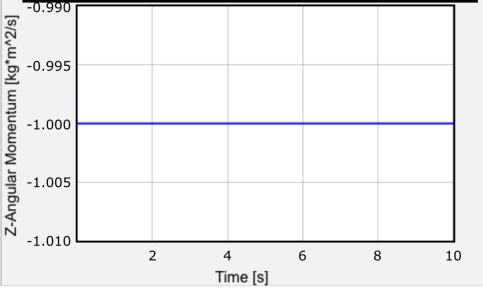
Here is a plot of the z-component of the angular momentum in this case.
Notice that it’s constant. Oh, I assume you know about cross products—they are in vpython, so you don’t have to do it manually.
So, yes—angular momentum is conserved. No big surprise there. But what if you change the origin? Is angular momentum still conserved? Try it.
There is very little point looking at the moment of inertia. I’ll do that next.
Single object constrained to circular motion.
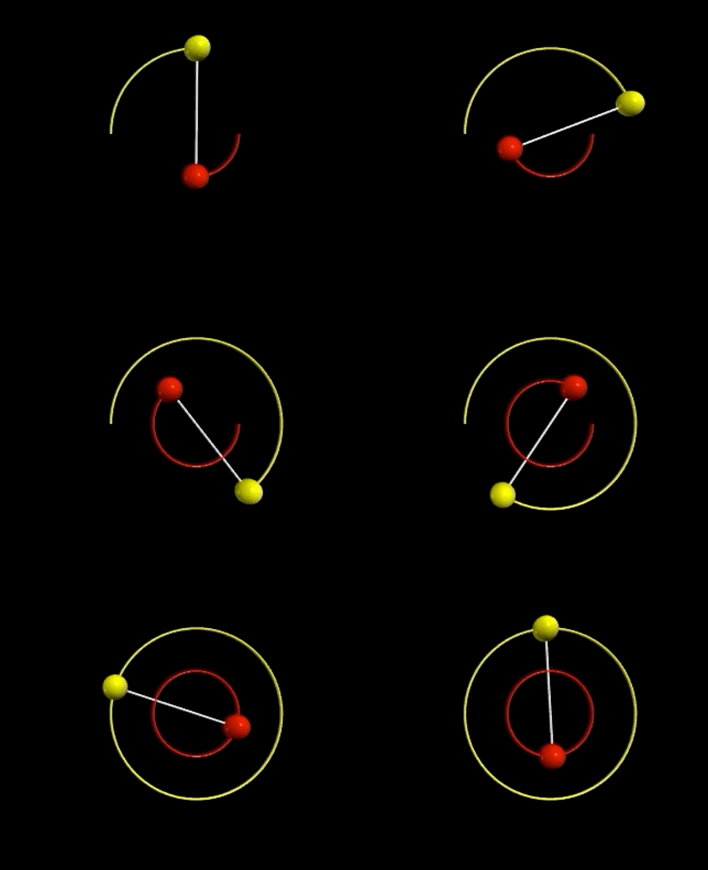
I want to get an object moving in a circle—but I don’t want to make some crazy constraint. This sounds like a job for THE SPRING. Yes, I will model an object moving in circular motion by using a spring attached to the object and some stationary thingy.
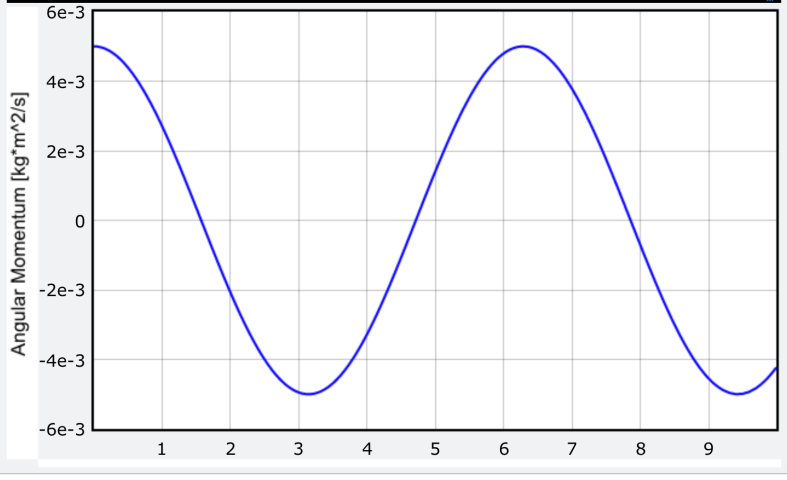
If you calculate the angular momentum (from the linear momentum), here is what you get.
It doesn’t look constant—but I think that’s just a rounding error. Reminder: this is the angular momentum from . What if I use the moment of inertia and the angular velocity? Do I get the same thing?
I can calculate the angular velocity as:
For objects moving about a fixed axis, the moment of inertia is a scalar value that is calculated as:
Notice that if you put these two definitions together, you get (essentially):
So it should work.
Two masses.
Using a stationary pivot point can cause some problems. Since the pivot point is stationary, there must be some external forces on the system. This means that calculating momentum and angular momentum can be difficult.
Yes, these are two unequal masses but the center of mass is stationary. Also, I will skip the graph, but angular momentum (the z-component) is constant.
What happens if the center of mass of the system is not zero? In this case, I need to redo the angular momentum calculation. First, for the point model, it would be still be r cross p, but I can write it two ways:
In this case, the 1r subscript means the position relative to the center of mass and the momentum relative to the center of mass. The com subscript means center of mass.
For the moment of inertia method, I have:
But this is where I will stop. For some reason, I can’t get a constant angular momentum using the moment of inertia. Here is the plot of the component of momentum for the case when the center of mass is moving.
I feel like I am making some silly mistake. So, here are some notes and comments.
Maybe I am calculating the relative velocity incorrectly.
Maybe it has something to do with my definition of the angular velocity.
Note that the two masses can have slightly different angular velocities since this isn’t actually a rigid object—it’s just mostly rigid (stiff spring).
I feel like I have so many different programs, that I’m losing track of what works (that’s why I wrote this blog post).
What’s the next step? Well, after getting this calculation to work—I have big plans. The ultimate goal is to have a 4 mass rotator (4 masses connected by springs) and calculate the moment of inertia and the angular momentum. I would be very happy if I could show that the angular velocity vector doesn’t have to be in the same direction as the angular momentum vector. That would be cool.
There should be a grave yard for blog posts that start, but never get published. Fortunately, I have this site. Here I can share with you my failed posts. Get ready.
It starts with this epic video from the Soyuz MS-10 failed launch.
That’s pretty awesome. It’s doubly awesome that the astronauts survived.
Ok, so what is the blog post? The idea is to use video analysis to track the angular size of stuff on the ground and from that get the vertical position of the rocket as a function of time. It’s not completely trivial, but it’s fun. Also, it’s a big news event, so I could get a little traffic boost from that.
How do you get the position data? Here are the steps (along with some problems).
The key idea is the relationship between angular size, actual size and distance. If the angular size is measured in radians (as it should be), the following is true where L is the length (actual length), theta is the angular size, and r is the distance.
Problem number 1 – find the actual distance of stuff on the ground. This is sort of fun. You can get snoop around with Google maps until you find stuff. I started by googling the launch site. The first place I found wasn’t it. Then after some more searching, I found Gagarin’s Start. That’s the place. Oh, Google maps lets you measure the size of stuff. Super useful.
Finding the angular size is a little bit more difficult. I can use video analysis to mark the location of stuff (I use Tracker Video Analysis because it’s both free and awesome). However, to get the angular distance between two points I need to know the angular field of view—the angular size of the whole camera view. This usually depends on the camera, which I don’t know.
How do you find the angular field of view for the camera? One option is to start with a known distance and a known object. Suppose I start off with the base of the Soyuz rocket. If I know the size of the bottom thruster and the distance to the thruster, I can calculate the correct angular size and use that value to scale the video. But I don’t the exact location of the camera. I could only guess.
As Yoda says, “there is another”. OK, he was talking about another person that could become a Jedi (Leia)—but it’s the same idea here. The other way to get position time data from some other source and then match that up to the position-time data from the angular size. Oh, I’m in luck. Here is another video.
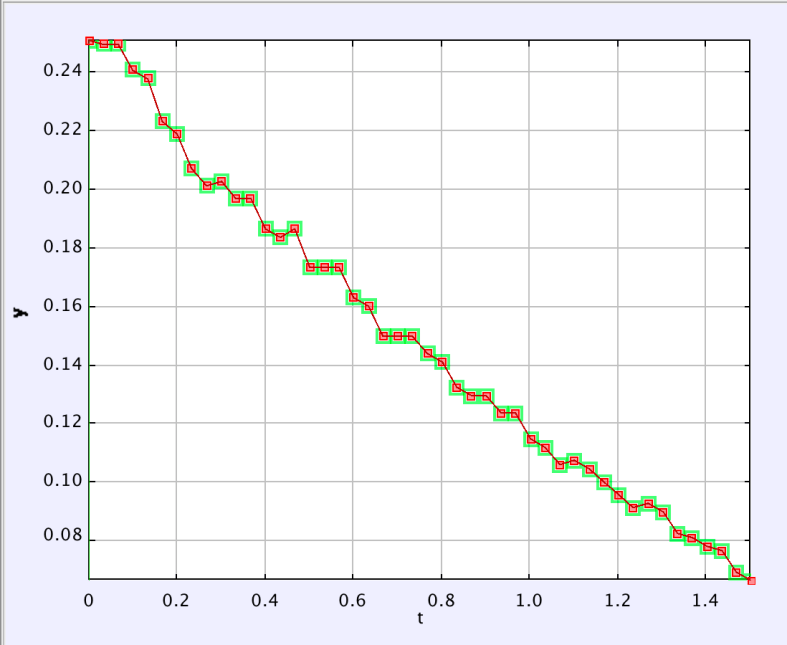
This video shows the same launch from the side. I can use normal video analysis in this case to get the position as a function of time. I just need to scale the video in terms of size. Assuming this site is legit, I have the dimensions of a Soyuz rocket. Boom, that’s it (oh, I need to correct for the motion of the camera—but that’s not too difficult). Here is the plot of vertical position as a function of time.
Yes, that does indeed look like a parabola—which indicates that it has a constant acceleration (at least for this first part of the flight). The term in front of t2 is 1.73 m/s2 which is half of the acceleration. This puts the launch acceleration at around 2.46 m/s2. Oh, that’s not good. Not nearly good enough. I’m pretty sure a rocket has an acceleration of at least around 3 g’s—this isn’t even 1 g. I’m not sure what went wrong.
OK, one problem won’t stop me. Let’s just go to the other video and see what we can get. Here is what the data looks like for a position of one object on the ground.
You might not see the problem (but it sticks out when you are doing an analysis). Notice the position stays at the same value for multiple time steps? This is because the video was edited and exported to some non-native frame rate. What happens is that you get repeating frames. You can see this if you step through the video frame by frame.
It was at this point that I said “oh, forget it”. Maybe it would turn out ok, but it was going to be a lot of work. Not only would I still have to figure out the angular field of view for the camera, but I need to export the data for two points on the ground to a spreadsheet so that I can find the absolute distance between them (essentially using the magnitude of the vector from point A to point B). Oh, but that’s not all. When the rocket gets high enough, the object I was using is too small to see. I need to switch to a larger object.
Finally, as the rocket turns to enter low Earth orbit, it no longer points straight up. The stuff in the camera is much farther away than the altitude of the rocket.
OK, that’s no excuse. I should have kept calm and carried on. But I bailed. The Soyuz booster failure was quite some time ago and this video analysis wouldn’t really add much to the story. It’s still a cool analysis—I’ve started it here so you can finish it for homework.
Also, you can see what happens when I kill a post (honestly, this doesn’t happen very often).
Actually, there is one other reason to not continue with this analysis. I have another blog post that I’m working that deals with angular size (ok, I haven’t started it—but I promise I will). That post will be much better and I didn’t want two angular size posts close together.
Getting through a giant chunk of cement with acid.
Really, this isn’t a “Mac Hack” since MacGyver didn’t do it. Instead it was someone else. She used muriatic acid to help get through a tunnel that was plugged up with cement (or concrete—I always get those two confused).
But yes, muriatic acid will indeed “eat” through cement. If the goal is to create a hole that will allow a human to get through, it’s not so bad. You can use the acid to weaken enough of the structure that you can take it out in pieces. You don’t have to dissolve all the cement.
Now for a bonus homework question—actually an estimation problem. Suppose there is 10 feet of cement to get through. If someone uses muriatic acid, how long would this hole take to make? Go.
Thermite
Thermite is awesome—oh, and slightly dangerous. Basically, it’s a chemical reaction between two metals in which one of the metals has the oxygen needed for the reaction (like iron oxide). The key to getting this reaction to work is to have super tiny pieces of metal (like super super tiny). Really, that’s the tough part. But once you get that, the thermite gets really hot, really fast. Hot enough to melt stuff.
Could it be used to close up gun ports in an armored vehicle? Probably.
Pressure to open an armored vehicle
An armored car has armor. That’s why they call it an armored car. The primary role for the armor is to keep out things like bullets and people so that the stuff inside (probably money) is safe.
But what if you seal off the openings and then pump in some air? The cool thing about air pressure is that even a small pressure increase can exert HUGE forces on a wall. Let’s say that MacGyver doubles the atmospheric pressure inside the truck so that it goes from to . If you have a wall that has dimensions of 2 meters by 2 meters, there would be a net outward force of pushing it outward. For you imperials, that is like 90,000 pounds.
Oh, this is why submarines are cylindrical shaped. Flat walls bend under great pressure.
DIY balance
I really don’t know how much detail to go over for this hack. MacGyver builds a simple balance scale to find the weight of some money. As long as the arms are equal, this should be easy. Maybe in a future post (on Wired) I will show you a design for a symmetrical balance scale.
Pry Bar Lever
Again, there’s not too much to say here. MacGyver uses a piece of metal to pry open a door. This is why humans use crow bars. In short, this is a torque problem. The torque is the product of force and lever arm. So a small force with a large lever arm (MacGyver pushing on the end of the bar) gives a small lever arm and huge force (from the tip in the door).
Ok, I lied. Torque is way more complicated than that. Really, it’s a vector product:
That’s a little better.
Oh, there were two good hacks that didn’t make it into the show. Too bad.








 where L is the length (actual length), theta is the angular size, and r is the distance.
 to
to  . If you have a wall that has dimensions of 2 meters by 2 meters, there would be a net outward force of
  pushing it outward. For you imperials, that is like 90,000 pounds.
 Rhett Allain's Stuff