Picking up trash

There was this very nice lady in our neighborhood.  She would take it upon herself to pick up trash along the main road next to the subdivision.  Super nice lady.

Well, she moved.  She moved to live with her kids (she was older).  So, as a way of respecting her service I went on amazon and ordered a pair of those stick grabber things.  Now it would be my duty to keep that road clean.

The first time I picked up trash, my oldest daughter volunteered to go with me.  There was a BUNCH of stuff.  Crazy stuff.  I think we filled up three trash bags for about a mile of road.

Cigarette butts are all over the place.  Styrofoam cups, beer bottles, vodka bottles, and other various things (some of which I shouldn’t mention).  It was hot and buggy.

But in the end, we finished.  The road looked better.  The next day, I saw a cup. WHAT THE HECK???? I just cleaned up (we just cleaned up) and there already was a stupid cup on the side of the road.  Who does this?

So now, I go about once a week.  I pick up trash.  It’s hot – but I really like it.  It’s like one of those chores that you oddly enjoy.  It’s like vacuuming the floor and it looks all neat afterwards.  Or mowing the lawn, or cleaning the bathroom.  I sort of like these jobs that clearly make a difference.  On top of that, picking up trash is about more than just me – it’s a sort of community service.

Oh, and I get some exercise too.  To summarize: don’t pick up trash on the road – it becomes addicting.

The worst high school physics question EVER

Here is a multiple choice question from an online high school physics question.  It’s bad, but it’s probably not actually the worst ever.

It goes something like this:

You have three objects that start at the same temperature.  Which one cools off the fastest?

  1. A dry bean
  2. Toast
  3. Water

What is your answer and why is this bad?

I’ll be honest, I answered this question incorrectly – well, I should say that my answer didn’t agree with the key.  Let’s go over the options.

Water

I’m starting with water because this is the answer I chose.  Why would water cool off the fastest?  My assumption was that the water would evaporate and cool off the liquid more than the other two objects.

Of course the evaporative cool depends on several things:

  • The water temperature
  • The air temperature and humdity
  • The volume of water
  • The surface area of water.

If I take some water and pour it into a very shallow pan with a large surface area, this stuff is going to cool off quick.  Note: here is an older post about evaporative cooling.

This answer was wrong.

Toast

This was my second answer.  What is special about toast and why would they choose it?  In my mind, toast is special because it has lots of holes.  Lots of holes means that it has a large surface area to volume ratio.

Since things radiate thermal energy through the surface area, things with high surface area to volume ratios cool off faster.  This is why small objects cool off faster than large objects.  This is also why the moon’s core is cooler than the Earth’s core (the moon is smaller).

Oh, this is also how a heat sink works.  Large surface area to volume ratio.

This answer was wrong.

Dry Bean

A dry bean could cool off the fastest because it is small (high surface area to volume ratio) and it is low density.  I assume if it has a low density it has a low specific heat capacity.  This means that with a low specific heat capacity, the dry bean has a small amount of thermal energy even though it has the same temperature as the water and the toast.

This is essentially the same reason that you can put pizza on aluminum foil in the oven.  Once it is hot, you can touch the aluminum foil, but not the pizza.  Although they are at the same temperature, the aluminum foil has less thermal energy to burn you (because of the low mass).

This was the correct answer (according to the people that wrote this dumb question).

Writing questions isn’t so simple

I think what the author really wanted to ask was “which has the lowest thermal energy?”  But even then, you have to take mass and specific heat capacity into consideration.

It’s really just a super bad question.  Super bad.  Oh, but it’s probably not the worst one.  I saw some others that were just as bad if not worse, but I have blocked them from my memory.

Reflections on Student Video Assessments

After the summer session of physics (algebra-based), I have the following comments.

  • It seems like every other video has a problem with vector notation.  Students often set a vector equal to a scalar.  Frustrating.
  • Students seem to confuse two standards: The Momentum Principle and Collisions.  I have students submit videos for the momentum principle that are just a collision.  The key point is that the momentum principle deals with force, time and change in momentum.  I guess this is my fault. I offered suggested homework problems from a textbook and it covered momentum and collisions in the same chapter.  I guess they thought they were the same thing.
  • Students are not very skilled at picking problems to solve.  They like the lowest level of something like “mass is 2 and velocity is 3, what is the momentum?”. I tried to help them, but it didn’t seem to work.  I showed a bunch of questions in class and had them “rate” them then discuss what makes a good problem. (I think I wrote about that here on my blog).
  • I’m still not happy with the “student review”.  I want students to watch other student videos – but I don’t know how to implement that.
  • Students like to procrastinate.  I’m getting a bunch of redos on the last day of submissions.  That sucks to grade.
  • I hate vertical videos – but I hate videos that are recorded sideways even more.  I stopped accepting the sideways videos since they can fix it and send it back to me.
  • I try to give meaningful feedback in my responses – but sometimes I just give a grade (score out of 5 points).
  • I’m trying to give higher scores.  If they do well on the in-class assignment and submit multiple videos that aren’t wrong, I typically will at least give a 4/5.

Numerical Calculation Collection

The following are some of my best posts about numerical calculations.

Working notes for my bouncing ball running model

I’ll be honest.  I had some problems getting my bouncing ball running model working.  Oh, here is the model.

https://www.wired.com/story/how-is-a-runner-like-a-bouncing-ball/

Basically, this models the speed of a running human by assuming they are bouncing ball.  When the human impacts the ground, there is some maximum impact force and an impact time.  The impact time decreases with horizontal velocity such that eventually, all the force is used in the vertical direction to keep the human off the ground long enough to switch feet in the air.  The end.

As I was making this model, I took some notes because I couldn’t get it to work.  Here are my notes.  Hopefully you can use this to see how to troubleshoot a program.

Running model notes

I think I mostly have it working:

http://www.glowscript.org/#/user/rhettallain/folder/blog_posts/program/runningbouncemodel/edit

Here is basically how it works.  Two big ideas:

  • Humans can push off the ground with some maximum force.  This force does two things – gets them off the ground and in the air so legs can move and pushes them forward
  • The contact time with the ground is small and gets smaller as horizontal speed increases
  • This means as the human speeds up, the ground force eventually gets to where it can only push up and not forward

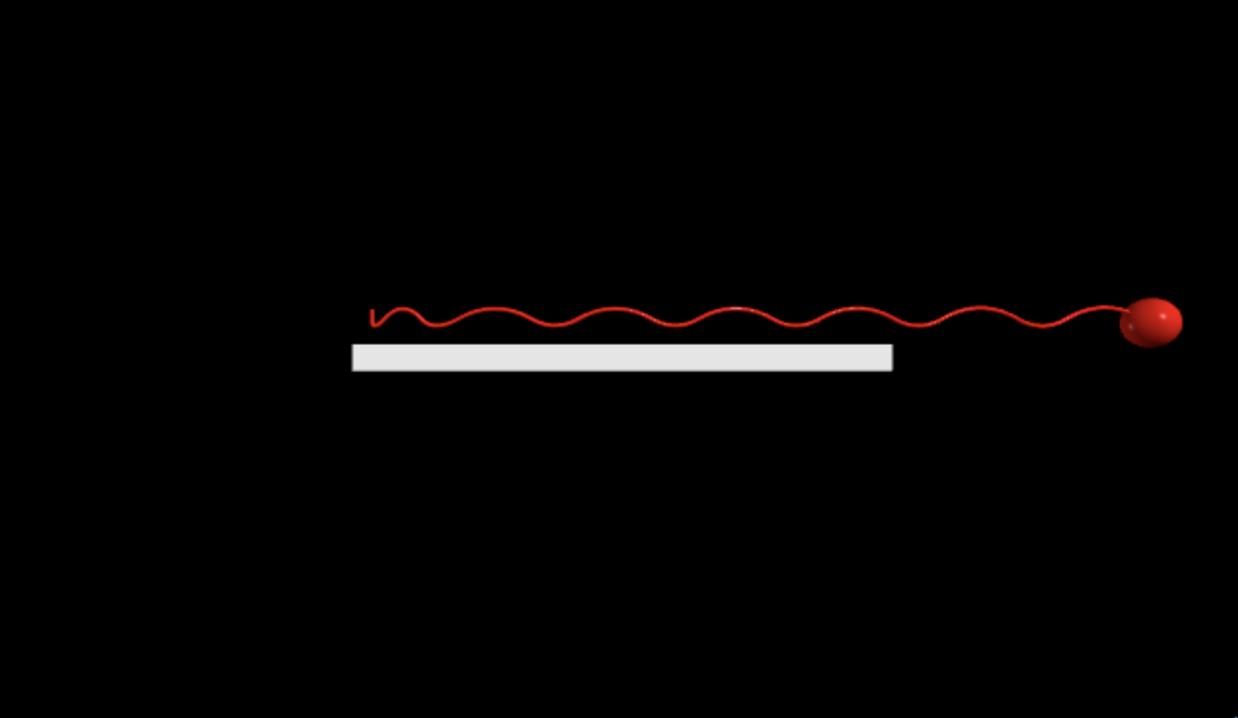
Here is what it looks like so far

Here is a graph of speed vs. time

  • This model reaches a max speed of about 3.5 m/s in just a couple of strides – that doesn’t seem right
  • I think my Fv calc is wrong – it gives back the same speed not the needed vertical speed to get the stride time
  • Need to recalcualte Fv based on pfinal
  • If you want to be in the air for ts seconds, then your initial vertical velocity must be -g=dv/dt.  dv=g*dt dv = 2vstart. start=(½)gdt
  • Now to calculate the force. I know tc (contact time) so F = dp/dt = m*(vy2-vy1)/tc – this is the total force = Fv-mg so Fv = that stuff +mg

Something isn’t right.  Here is a plot of position vs. time

It’s getting higher and higher (and going lower – weird)

  • I’m getting stride (in air) times of 0.09 to 0.13 – that’s wrong


Ok – I think I know the problem.  I need to set the force push time loop and forget about while human.pos.y<R – I think that’s my problem


How about this

  1. Once human hits the ground – calculate Fv, Fx, and tc set tcount = 0
  2. While tcount < tc – set human.pos.y = ground. And set the forces
  3. When tcount = tc, turn off the forces and stop holding the person


It appears there is something wrong with my Fx.

  • Fx is some value for the first push – but after that it goes to zero and the Fv is maxed out.
  • Werid
  • There is a problem with both Fv and Fx


The problem is the time of impact – it gets too small such that the required force is HUGE

  • How about a min time – and it can’t go lower?


Fmax = m*2v/t

t=m*2*v/Fmax


I think the problem is that during the contact time, the horizontal force is too much so that the human ends up going faster than the theoretical speed.


I can use the time and force and velocity to estimate the average velocity and then recalculate the time

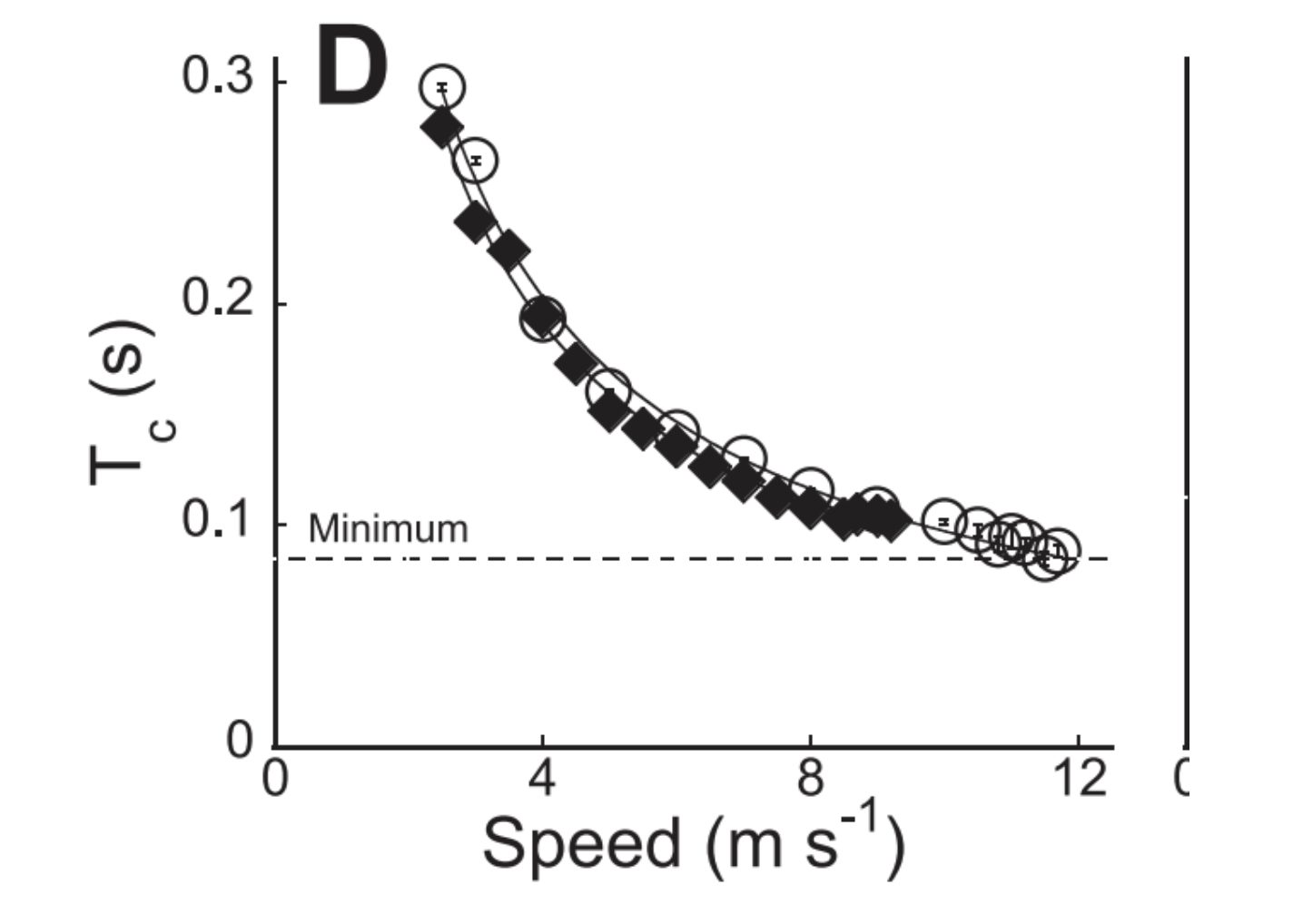
This is the paper

https://www.physiology.org/doi/pdf/10.1152/japplphysiol.00947.2009

It has this plot.

This shows a decrease in contact time with speed

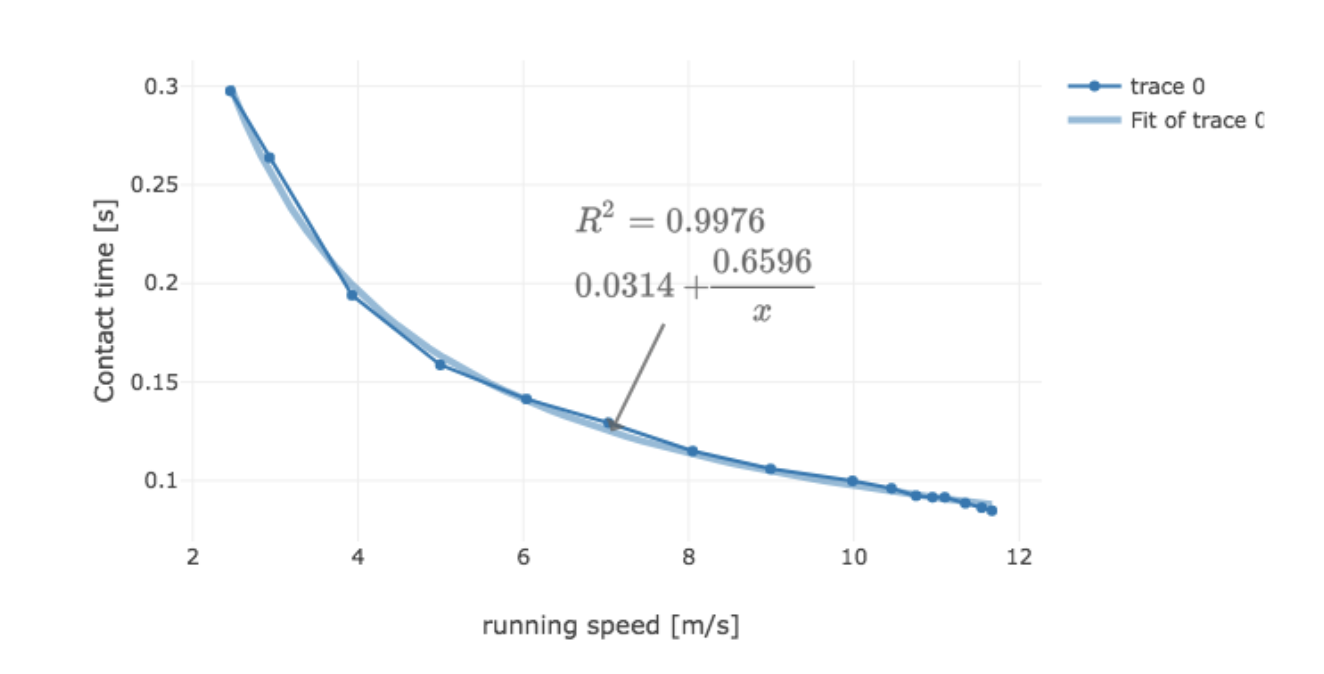
Here is what I get for a fit

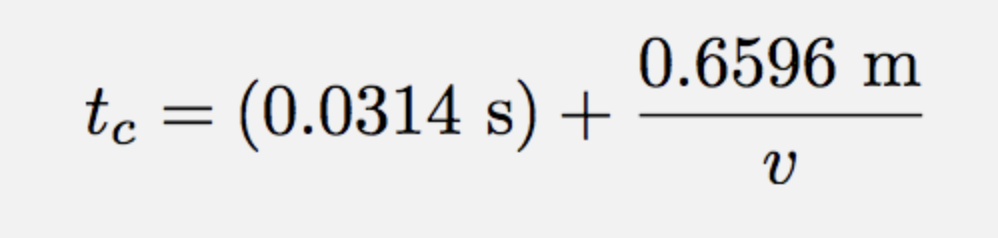
This gives a contact time function of

Although this “blows up” at v= 0.  Maybe I should say tc = 0.3612 for v < 2 and this expression for v>=2

End of notes – it finally worked.

Peltier Cooler

I have this small wine-refrigerator that is both old and not working.  I don’t really need it, but it’s nice to keep extra beers and wine in there.

My idea is to get a peltier cooler and convert this from a compressor cooler to a solid state cooler.  Of course it won’t be as efficient or cold – but as long as it gets just a little bit cooler I will be happy.

I ordered some coolers online (they weren’t super expensive) and they seem to work. It requires 12 volts and up to 5 or 6 amps – so the power supply might be an issue (it seems many people use a computer ATX power supply).  Actually, you can just connect it to a D-cell battery and put your fingers on each side of the cooler and easily feel a temperature difference (great for demos).

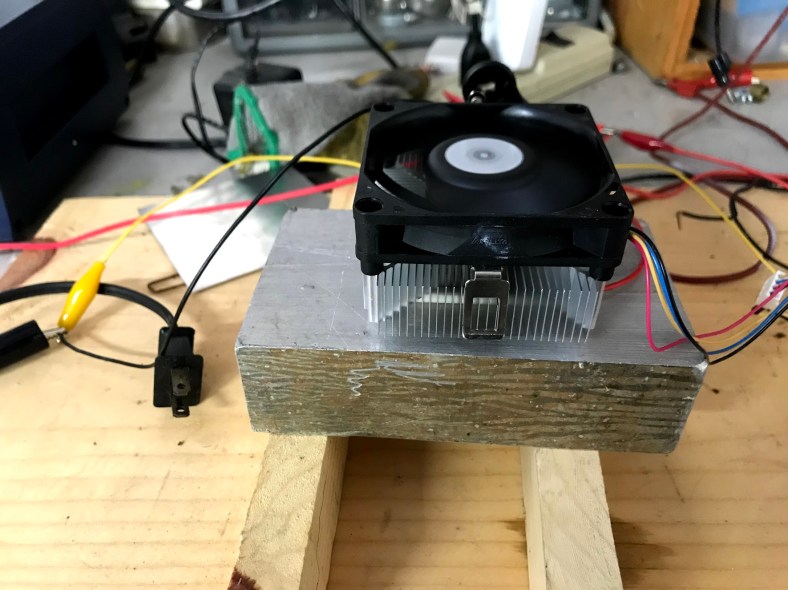
With a temporary power supply, I put the cold side of the peltier on a big aluminum block and then I put a cpu heat sink on the hot side.  This didn’t work – but here is a picture.

IMG_4732.jpg

It turns out that the peltier cooler gets hot – but it keeps a temperature difference between the two sides.  So the key is to keep the hot side as cool as possible.  With this in mind, I switched it so that the hot side was on the block and there was nothing on the cool side.  I still didn’t work very well until I put some thermal paste between the peltier and the aluminum block for good thermal contact.

Here is what I get.

Pretty cool, right?

I will keep you updated.

Trinket Physics Update

Ok, it’s the summer.  Yay (not yay).  I’m currently teaching a summer section of algebra-based physics and it’s pretty tough since they meet for 1 hour + 15 minutes 4 days a week.

Anyway, my goal was to finally finish my trinket physics book and use that for class.  I’m not going to finish it by the end of the semester, but I have learned some things.

  • Stick to your narrative.  I started off with my own idea but then it sort of merged into something that would match up more with traditional textbooks.  DON’T DO THIS!  I need to stick to the original plan (which I will lay out below).
  • More calculations with python.  There are some parts that don’t have much python.  MORE COWBELL.
  • My original plan was to use the momentum principle.  However – there is a problem.  I start off with kinematics (and acceleration) and you need acceleration for circular motion.  My new idea is to introduce the momentum principle as \vec{F}_\text{net}=\frac{\Delta \vec{p}}{\Delta t} = m\vec{a}.
  • Case studies are great.  I like to take something like orbital motion and just explore a bunch of stuff.
  • Students want more homework.

Ok, here is my new plan.  Break the curriculum into 4 parts.

  • Kinematics (position, velocity, acceleration).
  • Momentum Principle
  • Work-Energy
  • Angular Momentum Principle

That means some stuff gets skipped.  I don’t need to focus on statics so much – or special forces.  Focus on the big things – planet motions are great.

More to come.

Summer and Hot Stuff

Here are some posts about summer and hot weather and other related stuff

Video Game Physics

Below is a list of blog posts about video games and physics.

Angry Birds Stuff

Other Video Games