Let me start off by saying that I mostly agree with Jack. There is a good chance that Ewoks eat people (human people). Why else would they put Luke and Han on those roasting sticks. It sure looks to me like they were going to roast them and then (logical next step) eat them.
Oh, in case you didn’t know. The original plan was to have some super intimidating creature that the Rebels first fear and then team up with. These creatures were going to be the wookiees. When George Lucas started Episode IV, he didn’t know if he would get to the last movie—and he really liked the wookiees. He decided to put one in as Chewbacca. That left the Ewoks in Episode VI. (see The Secret History of Star Wars)
MRE Hot Sauce Bomb
It’s sort of a bomb. Really, it’s supposed to be a type of tear gas. Of course an MRE is a “meal ready to eat”—but it’s even better to eat if you heat it up. Most MREs come with a chemical heater. It’s a small package that gets hot when water is added. Along with getting hot, it also produces a gas. This gas is the source of the bomb. All you need to do is to put the heater and water in an enclosed container and the interior pressure will eventually build up and explode.
For MacGyver’s version, he adds hot sauce. When the water bottle explodes, it spreads hot sauce everywhere. Yes, pepper spray is essentially hot sauce (but very hot hot sauce).
Tire tool slingshot
Really, there’s not much science here. MacGyver uses bungee cords to launch a tire tool (one of those things to remove wheel bolts) at a car. This would pretty much work, but it might be tough to get a good hit.
Jack Heart Pump
The “heart in a box” breaks. Instead of replacing the broken pump with a traditional pump, MacGyver uses Jack’s heart as the pump. It’s sort of funny.
Scooter Generator
Most generators are just some method to turn an electromagnetic coil to create electricity. You can use wind, water, steam, or yes—a gasoline engine. In this case, MacGyver connects a scooter to the generator. Boom. Power.
Warning: don’t mess with lasers. You might think everything is fine, but later you start seeing spots. It’s possible that your eye doesn’t respond fast enough to intense laser beams leading to eye damage. So don’t do anything stupid with lasers.
That being said, it is indeed true that a DVD burner has a nice laser in it. Here is a nice video showing how that works.
Now for the important question: could you use a laser to cut through the roof? Yes, that is indeed possible. However, it would take quite a bit of time unless you had an industrial strength laser.
Sonic Fire Extinguisher
The sonic fire extinguisher is real. Check it out.
Really, there’s not more more to say. The pressure waves from the low frequency sound prevents the oxygen from getting to the fire.
Jet Fuel and Starting a Jet Engine
What is jet fuel? Here is a great comparison between different fuels.
Now, how do you start a jet engine? Here is another video.
Essentially, you have to get air flowing through the engine in order to get the ignited fuel to work. Yes, it’s sort of complicated.
But how do you make jet fuel from crude oil? Well, as I understand it—crude oil has many chemical chains of carbon stuff. If you boil the oil, you can get different length chains to condense at different heights. This allows you to separate the different fuels.
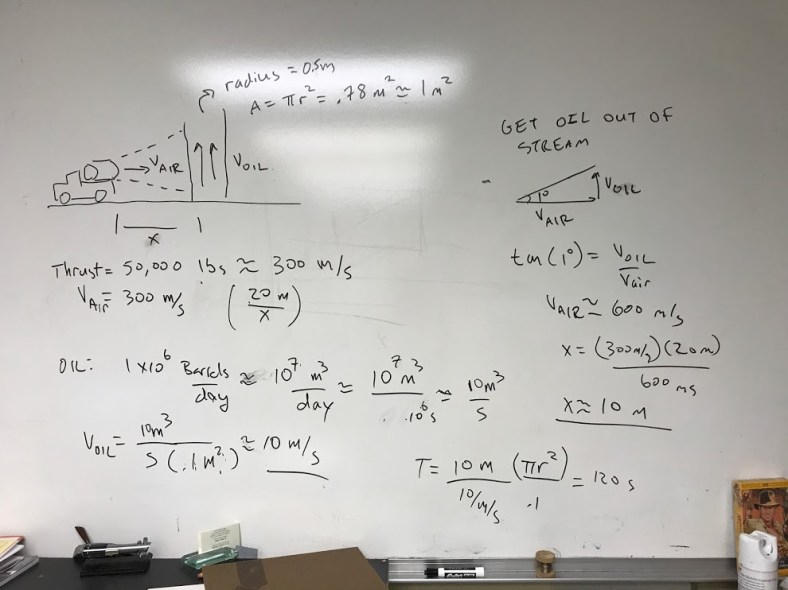
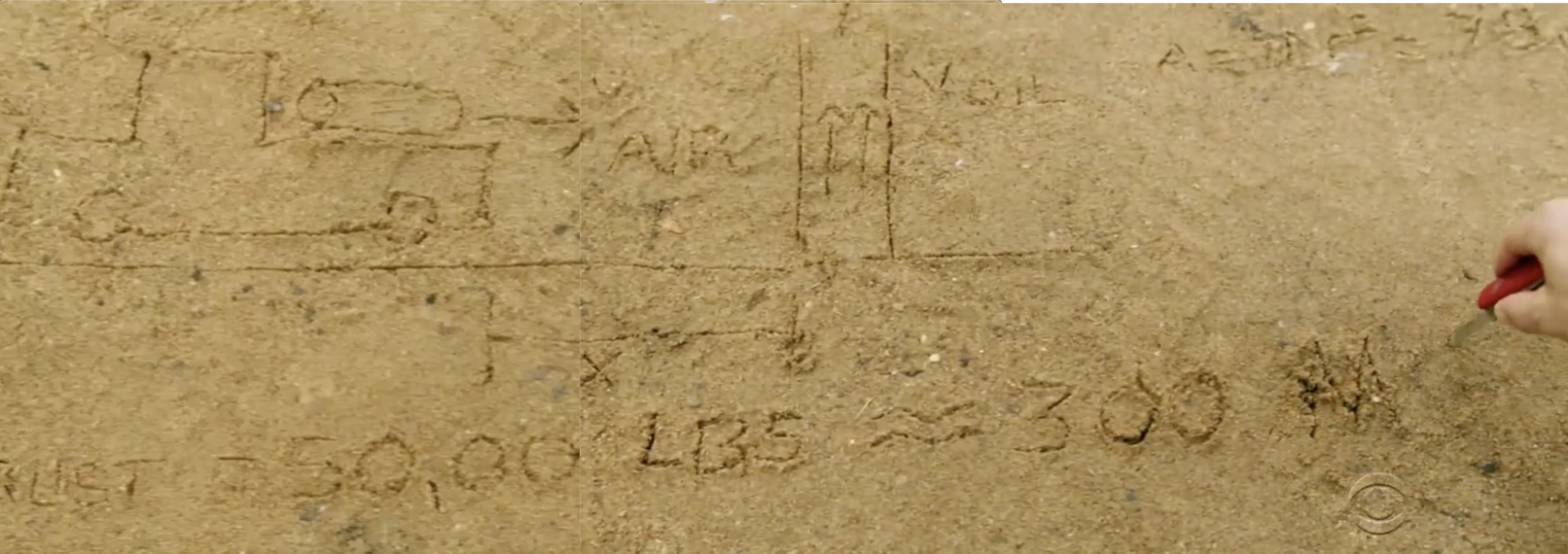
You might have missed it, but MacGyver needs to calculate how close the truck with jet engine needs to get to the fire in order to put it out. Here is his work (he wrote it in the sand).
That’s sort of difficult to read. Here is my version.
The basic idea goes like this:
The fire is shooting up with the oil moving up at some velocity.
With the jet engine pushing sideways, the net oil flow will be at an angle.
If the side air is fast enough, it will push the oil out of the stream and stop the fire.
Now for the trick. In order to make the calculation more interesting, I am assuming the the velocity of the air from engine decreases with distance from the engine.
Finally, let me add that a jet engine on a truck to fight a fire is mostly real. Check this out (OK, it’s a tank and not a pickup truck).
As they decorate for Halloween, the crew builds this skeleton that is controlled by syringes. The basic idea is to use a tube to connect two syringes (the big kind). Fill it with water. When you push or pull on one syringe, it makes the opposite thing happen with the other syringe since water is incompressible.
Here is a nice video showing how to make something like this.
Directional Antenna
In order to track down a dude, MacGyver builds a directional radio antenna. Well, actually he just combines a yagi antenna and a dish antenna—I’m not sure it would work like that, but it looks cool.
I don’t think I should go into the physics of a yagi—it might take a while to explain. However, I can say this: that old style TV antenna you had on your roof? That’s a yagi. It does have a directional dependance on amplitude. That means that if you point it one way, you will get a better signal than pointing it another way.
DIY Thermal Camera
How do you find people in a dark abandoned military base? What about a thermal camera? A “thermal” camera is just like a normal camera except that it’s different. Instead of detecting electromagnetic waves in the visible region (we often call this visible light), a thermal camera works in the infrared range. That’s why they are also called infrared (IR) cameras.
Normally, that wouldn’t help you see in the dark—except for one important thing. All objects radiate light. The wavelength of this light depends on the temperature of the object. For most of the objects you see around you, the wavelength of radiated light is in the infrared range. So, with an IR camera these objects are like their own little light bulb. You don’t need an external light source—the objects are the light source.
Let me show you an example. This is an image using the FLIR One—it’s an IR camera attachment for your smart phone (pretty cool). Here you can see the family dog in IR. There’s a bunch of cool stuff you can see, but I will just leave this post for you if you want to know more.
So, how could MacGyver make an IR camera? Step one would be to find one of these sensors—maybe lead sulfide detector. This detector just gives a voltage though and not an image. To get an image, you need to scan over the scene and then run that into a television or something. Here is an early sketch.
How far away could you detect a human? I tried this out using my kids and my FLIR One. Here’s what it looks like at a distance of 7 meters.
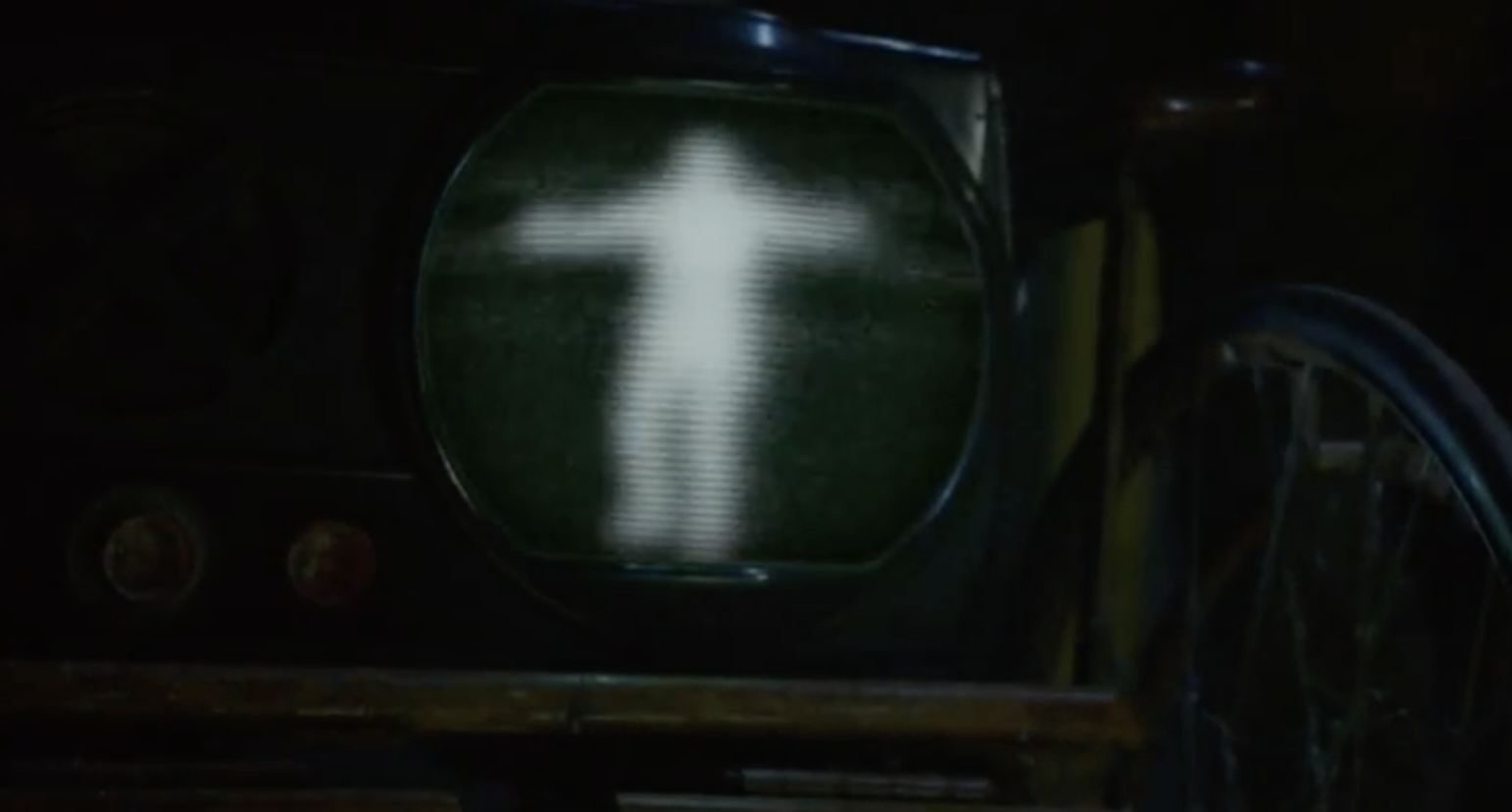
Just for fun, here is the image from the episode.
In the end, IR camera’s are pretty complex. Honestly, it’s amazing that we have something that does this on a phone.
Escaping a hyperbaric chamber
Samantha Cage has been placed in a closed hyperbaric chamber that’s being filled with water. A hyperbaric chamber is essentially a person-sized scuba tank. You can put someone in there and then increase the pressure. This can be useful for a person suffering from decompression sickness (from scuba diving).
Anyway, she’s trapped and needs to escape. MacGyver builds a captive bolt gun to break the window. Oh, that’s cool and all—but I have a better option to escape.
What if you sealed up the chamber to get her out? It sounds crazy, but it would work. Here’s the problem. In order to add water to the chamber, you either need to increase the interior pressure by adding high pressure water. Or—you can add water while letting some of the air out. The second method is much easier to do (since it just uses normal water). But this means there is either a valve that is open to let the air out or maybe there are some old and bad seals that let air out.
Now, if you seal off the chamber the water can’t come in. And if the water does indeed enter, it will increase the interior pressure. Hopefully the pressure will get high enough on the inside that Cage can add a little extra and bust out.
It’s just an idea.
Electromagnet Lift
Could an electromagnet actually lift something large? Absolutely. Have you not seen those giant electromagnets at the junk yard that lift cars? But what about a human? The human body doesn’t really have enough ferromagnetic material in it for this to work (unless you are Magneto). However, it’s at least plausible if that person has a steel plate implanted. Yes. It’s true that many metal implants are titanium. Also, the steel implants are stainless steel and some versions of stainless steel aren’t magnetic. But still—it’s possible.
An electromagnet is really just a coil of wire with current running through it. It’s not hard to make, here you can do it yourself.
But what about a HUGE electromagnet? If you want a super strong magnetic field, you need a GIANT electric current. It’s possible to get perhaps 10 amps out of a truck engine (from the alternator or the battery)—but that might not be enough. My suggestion is to get a bunch of car batteries together so that you can get the highest current possible. Of course this high current is going to make the wires hot, so don’t run it for too long.
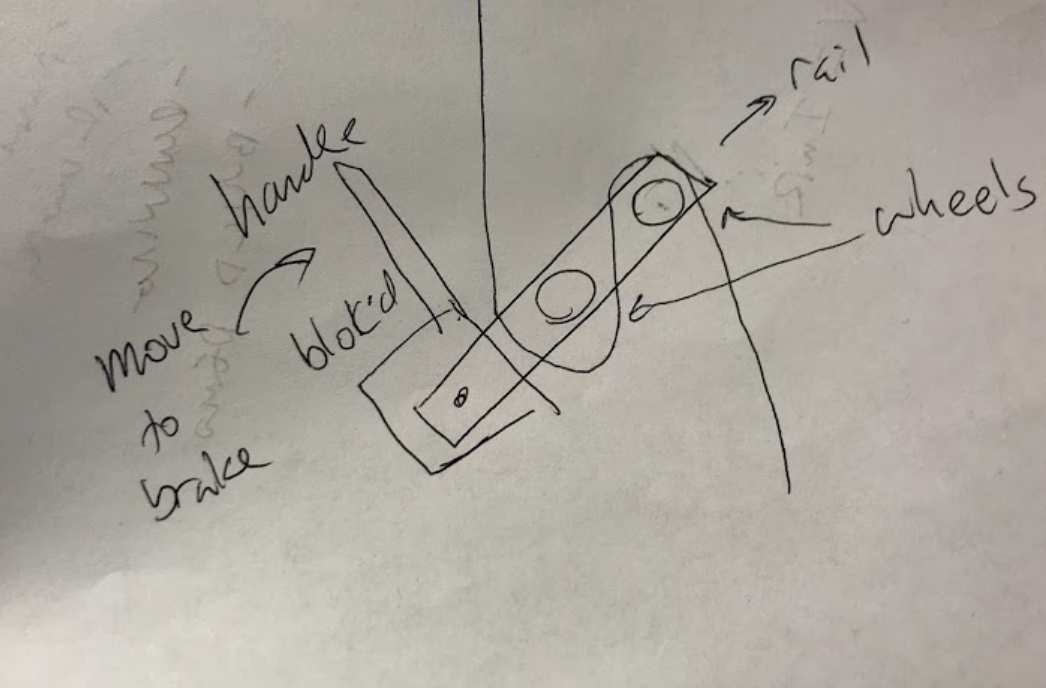
MacGyver needs to get down an elevator cable—to do this, he builds a descender. The basic idea is to “grab” hold of the cable to produce enough friction that it supports a human. That keeps you from falling. Of course you also want to move down, there needs to be some method to “inch” your way down. The one MacGyver builds looks like this.
Here is an early sketch for a type of descender
Of course the problem is that the elevator cable is under tension and very thick. It’s really more like a pole than a rope. That’s why the design in the episode would work better.
Two Bad MacGyver (Mason) Hacks
These aren’t bad hacks—they are hacks from the Bad MacGyver (Mason). First, there is the cable cutter. This is just a bolt cutter connected to an electric motor. That should work.
The other one is the hydrochloric acid in the basement of a building around support pillars. So, would this work? Well, hydrochloric acid does indeed dissolve concrete and cement—it’s not super fast though. Everyone likes to think of acid as being that kind in the movie Alien. It’s not like that.
Of course a pillar isn’t just cement. It has steel rods in there too. But acid will eat through steel as well—again, it just takes a while. But you don’t have to completely dissolve the pillars to cause destruction. Just making them weak could do the job.
Oh, it’s a good thing the hydrochloric acid is in plastic barrels. It would melt steel barrels.
Atwood Machine
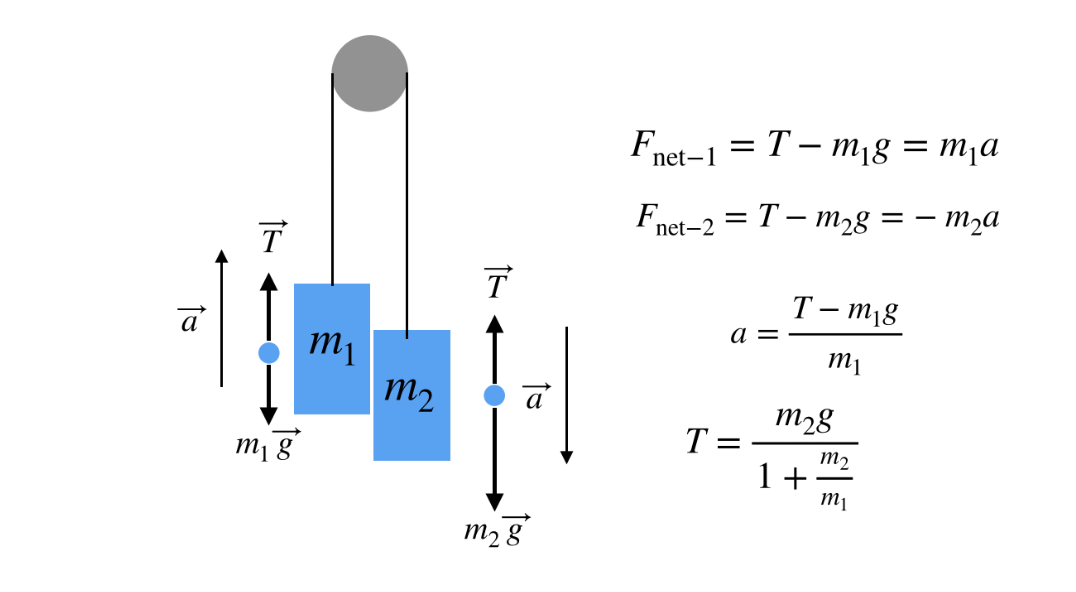
MacGyver’s plan is to connect one elevator to the one next to it. When the cable is cut, the two elevators will create an Atwood machine. This is of course a real physics problem.
The idea is to have two different masses connected by a string. This string then runs over a pulley. If the masses are different, the two masses will accelerate (one up and one down) with a constant acceleration. The key is that this acceleration will be much smaller than the acceleration of a free falling object. That’s a good thing since waaaaay back in the day, it was very difficult to measure the motion of an object with a large acceleration.
I think I will save the physics of an “Atwood Machine Problem” (no one really calls it that) for a later post. Instead, here is my calculation.
But wait! There’s more! This calculation would give you the tension in the cable, but once there is a tension the cable would stretch. How much the cable stretches depends on:
Tension
Cable length
Cable diameter
Type of material
So you see that the stretch really depends on two things—the material and the size of the cable. For the material dependence on stretch, we call this Young’s Modulus.
There is one more thing—maximum tension before a cable breaks. This also depends on the type of material and the shape of the cable. Here is a sample calculation.
Too bad MacGyver never got a chance to put these calculations into practice. Of course it’s Mason’s fault.
Recover Serial Number
It is possible to recover a serial number that’s scratched off a metal. Essentially, when the number is stamped into the metal there is a more than just a surface effect. The deeper metal is also changed in some way. Using acid, it’s possible show these differences and find this number. Yes, this is real.
For a circuit chip, the serial number is not likely to be stamped—it will be printed. Still, it’s entirely plausible that you could still recover some type of artifact.
This is another classic MacGyver hack. There is a window with bars on the outside and Mac needs to get IN. Simple, just pull off the bars. Obviously you can’t do this with your hands, you need to build something.
I guess you would call this a hand-crank winch. That probably best describes what he builds. Actually, it’s a hand crank winch WITH a compound pulley. Here are a couple of pictures.
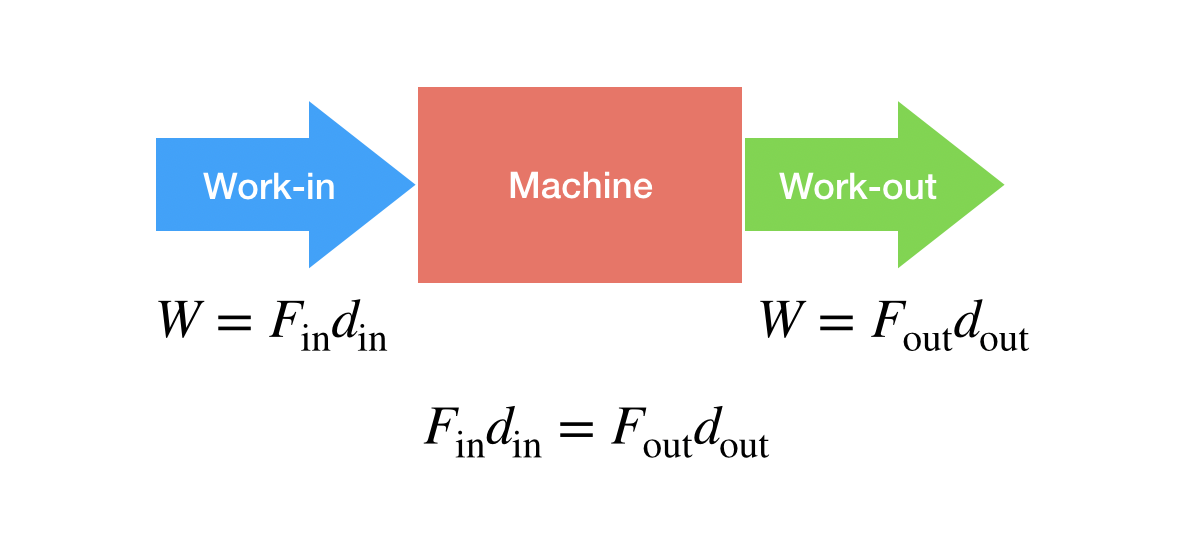
The main idea here is the same for ALL simple machines. It’s really about force, distance and work. Let’s start with a super basic definition of work (physics work).
In this expression (which isn’t technically correct—but that’s OK for now), W is the work, F is the force applied and d is the distance over which the force moves.
Now imagine I have a simple machine. I can put work into it and get work out of it. Assuming it is 100 percent efficient, the work in can’t be less than the work out (or you would get FREE ENERGY).
So, if you want to pull (or push) with a smaller force then you need to pull over a larger distance. For the output force, you need to have it move over a shorter distance to get a larger force.
With the winch, MacGyver turns a hand crank (part of the bike). If the garden hose (used for a rope) is wrapping around something with a smaller diameter, then for each rotation of the hand the rope will move a small distance. This is the key to a winch. Remember—smaller distance means larger force.
With the compound pulley, the same thing happens. By using multiple pulleys—you can make the pull force move over a larger distance thus increasing the output force.
Here is my initial diagram for how this might work.
Spark Gap Generator
You don’t get to see much detail here—so let me just explain the idea behind a spark gap generator.
First, I guess I should say what it is used for. Originally, a spark gap was a radio transmitter. It turns out that although it’s simple to build, you can only use one at a time because they don’t really use channels. In the case of MacGyver, he is using a spark gap to jam a phone signal (to prevent data transfer).
All of the wireless data works by broadcasting and receiving electromagnetic waves. Radio, microwave, visible light, x-rays…these are all electromagnetic waves (but with different wavelengths). Still, they are electromagnetic waves.
So, what about this spark gap? The idea is to create a repeating spark across some small gap. This spark is a very violent (electromagnetically speaking) event. It has accelerating electric charges which create EM waves. These EM waves are high enough intensity that they can make it such that other (more well behaved) devices can’t send or receive a signal.
But how do you make one of these spark gap generators? Really, you just need a battery and some wires. If you use the wires and battery you can create an electromagnet. That doesn’t make a spark, but if you can turn it on and off really quickly, then it will indeed make a spark. I built one using a moving metal switch. When the electromagnet is on, it pulls the metal and turns off the switch. Once the switch is off, the metal is no longer attracted to the electromagnet and it moves back in place to turn the electric current on again. This just repeats to make the spark.
Oh, here is another way to make one of these spark gap generators.
Gum Wrapper Switch
The key to this episode (it’s in the title) is gum. MacGyver activates the spark gap by taking out a piece of gum. How would this work?
The purpose of a switch is to do something such that two wires are connected. In this case, the two ends of the circuit could be the foil wrappers for two pieces of gum. If you put an insulator (gum) in between them, then the circuit will be closed. Pull the gum out and then two foil pieces will touch and complete the circuit.
Seeing in the dark using a camera and IR lights. MacGyver uses a digital camera and IR lights. The IR lights project light that humans can’t see, but a camera CAN see. This image then feeds into small video screens in front of his eyes so he can see in the dark (but the baddies can’t see).
DIY centrifuge. MacGyver needs a quick lab to analyze some crime scene blood (I think). The lab gets destroyed so he builds this home made centrifuge to spin the blood. The best part—it’s totally real. https://youtu.be/isMYGtCFljc
Photo phone. MacGyver is trapped in a house. He wires a microphone up to a light so that it turns on an off with the same frequency as sound. The other people are outside the house with a photocell connected to a speaker. This picks up the variations in light and produces sound. It’s real.
Least Plausible MacGyver Hack
Charging a phone with a Leyden jar. MacGyver needs to power a satellite phone. He builds a totally real Leyden jar (basically a capacitor) to store electric charge from a lightning strike. He then discharges this through the phone so that it will run. The theory is fine, it just probably wouldn’t work.
Stun gun on a slot machine. MacGyver needs a distraction. He grabs a taser and hits a slot machine. Blamo. The machine goes wild and starts giving out money. I mean, it’s possible—just not likely.
Technically, This Could Work
Jump out of window with a body bag and a fire extinguisher. Use the extinguisher to inflate the body bag as they fall out of window. The bag inflates and they land on the bag to cushion their landing. Yes, it could work. No—don’t actually try this.
Just about all of the explosions. Most of the explosives that MacGyver creates are based on real chemical reactions. However, the effect would either take too long or not be that powerful.
Most Scientific MacGyver Hack
See through walls with wifi. It’s real.
Creating anti drunk pill – based on dehydrogenase.
Normal means perpendicular. MacGyver tells Jack to put a bar normal to a wall in a trash compactor. Jack doesn’t know that normal means perpendicular and ends up hurting his arm.
The parsec is not a unit of time, it’s a unit of distance.
There aren’t a bunch of hacks in this episode—so that means I can just write about whatever I want.
Smoke Grenade, Oxygen Mask, Sticky Whips.
This is just classic MacGyver stuff. I really don’t have anything to add.
High Voltage Power Lines
Now we are talking. Why are these power lines high voltage? To answer this question, we need to first think about three things: power, voltage, current.
Let’s start with power. This is the rate of energy change (or in this case, energy loss). For an electrical circuit, the power loss is equal to the product of voltage and current.
But wait! There is also a relationship between voltage and current.
Where R is the resistance (in Ohms) of some element. Substituting this definition into the power definition:
So, here is your answer. You get more power loss with a greater current. That means the best option is to have low current power lines. But if you want to transmit power—you have to make up for this with high voltage. Boom. There’s your answer. OK, technically these power lines are alternating current and voltage, but the main idea still works.
Next question. What happens if you touch a high voltage line. The answer: not much really.
Yes, if you touch a high voltage line AND something else—like the ground then you will get zapped. The thing that really messes up humans is an electric current running through them. If you just touch one line and nothing else, there is no complete circuit. With no complete circuit, there is no electric current. Oh, this is why those birds can sit on power lines. As long as they only touch that one line, they are fine.
Belay from a lock
The key to a belay is friction. This is actually a pretty cool thing—the more turns a rope has around something (like a post), the greater the friction. You can control the amount of friction between the pole (or padlock in this case) and the rope by slightly varying the amount of rope around the pole.
I think I need to do an experiment to show this—maybe I will do that later. In the meantime, here is a nice tutorial on belays.
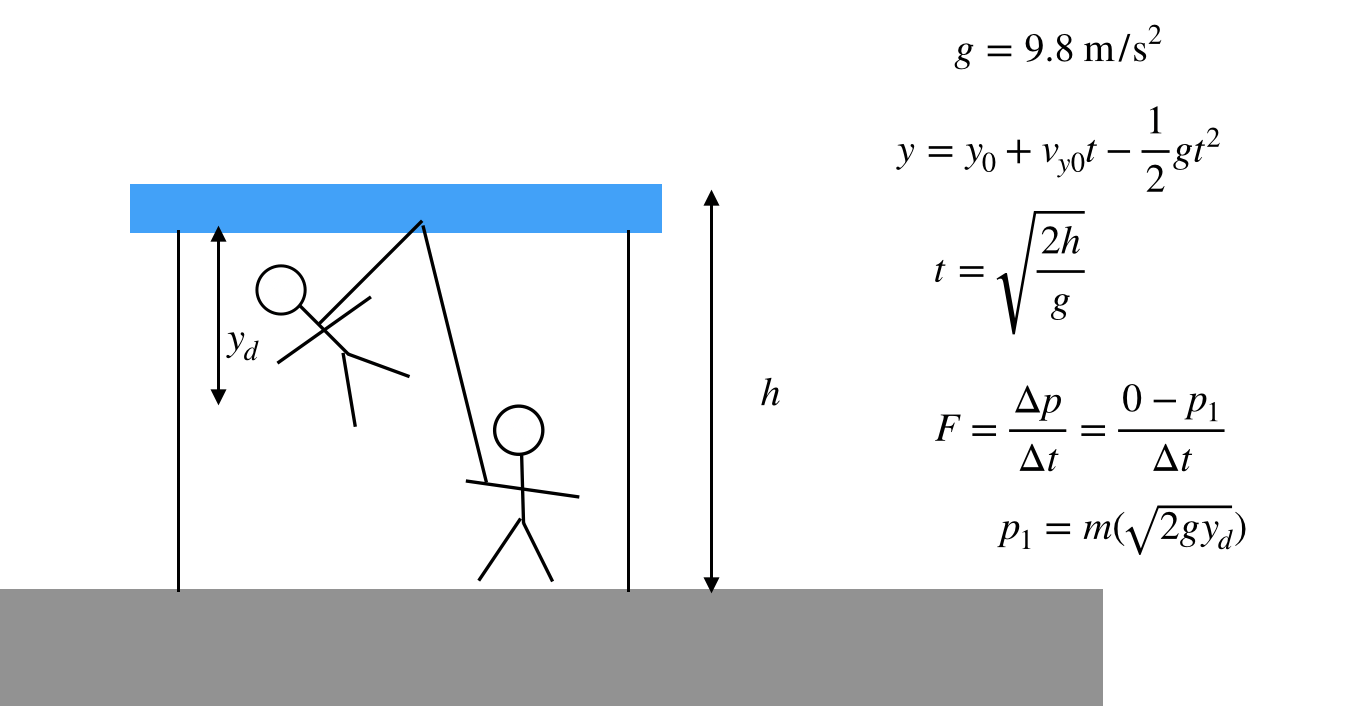
Oh, but what if MacGyver wanted to express his anxiety about heights by calculating the impact force if he fell. His calculation might look something like this.
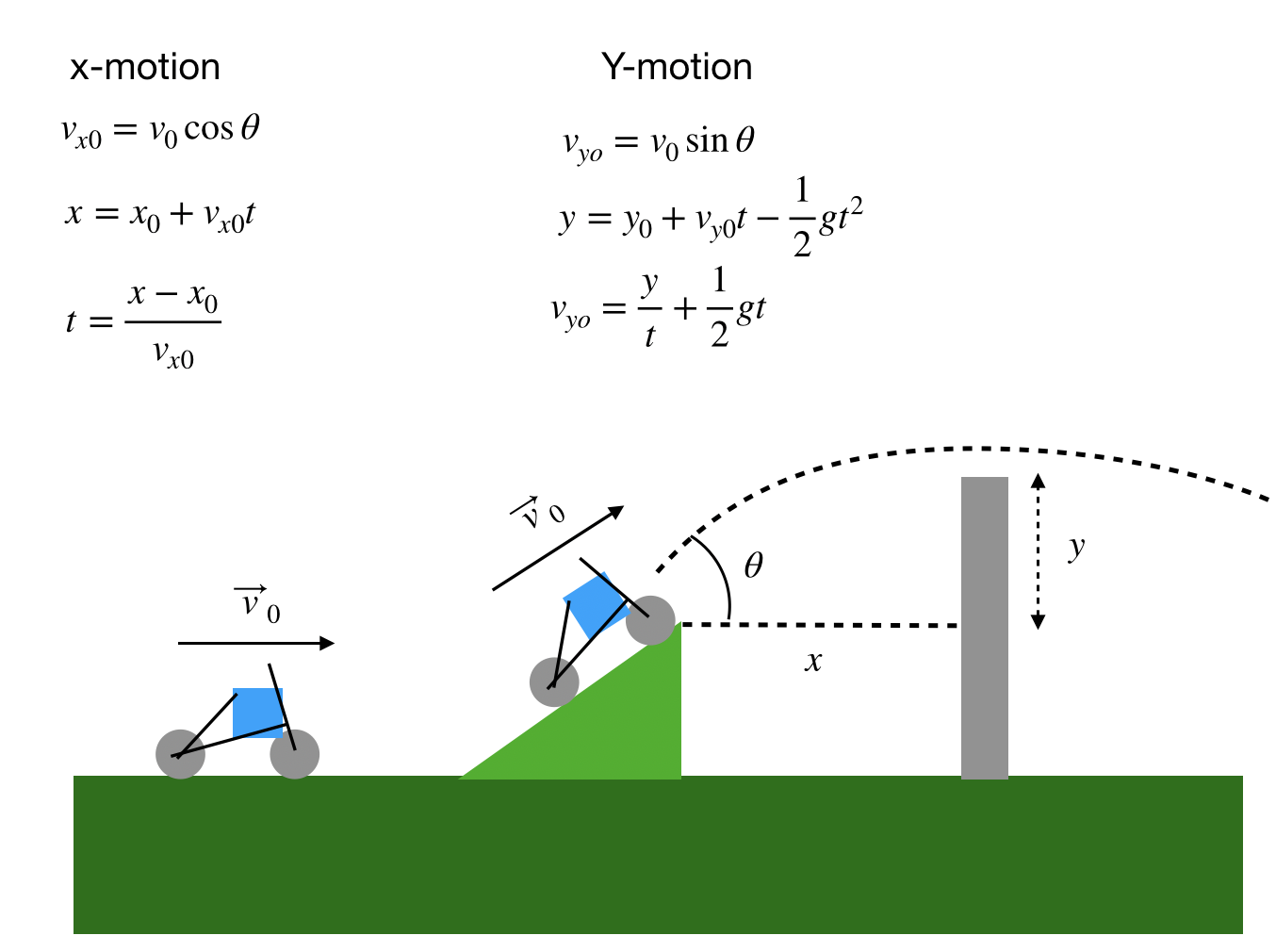
Motorcycle Jump
MacGyver and Desi need to jump a fence with motorcycles. Here’s what he might calculate to find the minimum motorcycle speed to make the jump.
The problem with a sinkhole is that the sides of the hole are unstable. You can’t just climb up the side or lower a rope down the side. This would just cause further collapse.
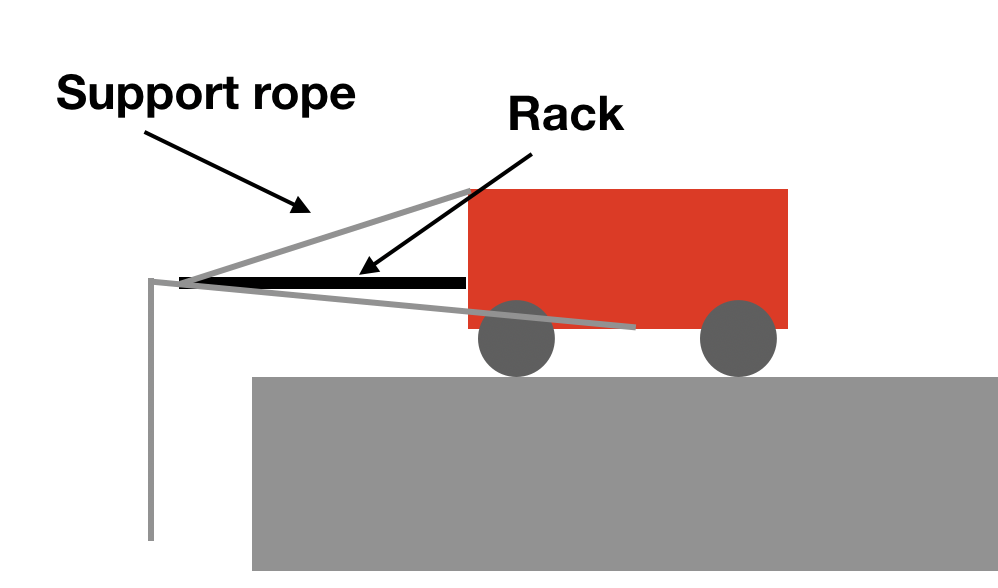
The answer is to get a crane. Something that sticks out over the edge of the hole, but doesn’t interact with the hole. Really, this is mostly just a nice build—but there is one physics thing to discuss.
You can’t just get a pole and stick it out from the truck and expect that pole to lift any weight of significance. It will bend or break. You need some type of structure to allow the crane to exert a torque on the end.
Here are two ways you could do that. First, you could make a type of truss. It might look something like this:
The triangle structure in the truss makes the whole thing rigid. Also, it allows multiple forces on the support end. There needs to be a force that will exert a torque to counteract the torque from the load.
The second method is to use a cable. I’m sure there is a technical term for this, but I’m just going to call it a cable. It would look like this.
I just realized that there was a mistake on the forces for the truss diagram. But you still get the idea.
Bonus, here is my initial diagram for this situation.
What about the tire and rope thing? Yes, this should work. MacGyver takes the rope and wraps it around the tire. This means that the truck’s engine can be the power to lift the humans out of the hole.
DIY Furnace
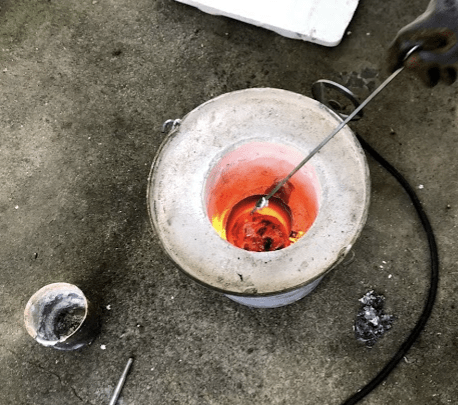
MacGyver needs to fashion a vascular clamp from some normal clamps. To do this, he builds a mini furnace. This is real. Actually, I built one of these with my daughter so that we could melt aluminum. Here is the video we started with. Note: this is awesome, but also dangerous.
This actually works. There is something amazing about melting metal with charcoal. We started off with a charcoal furnace and an old vacuum cleaner to blow in air. It works, but it goes through a bunch of charcoal really quickly. So, we switched to a propane version—this is much easier.
Bonus—here is my furnace diagram for the show.
Flash Bang
I don’t want to write about the flash bangs—but I should say there is a legitimate basis for this. I just don’t want to tell you.
OK, it’s not really a hammer. It’s more like a pressure gun. MacGyver hooks up a pressured line from a water heater to a tube with a rod in it. When the pressure is released, it shoots the rod and hits the door handle to knock it out. That’s great.
If you want it to “hammer” back and forth, you need to do something different. Here is a very basic design.
There is still a tube with a rod, but there are two differences. First, there is a hole on the side of the tube. As the rod moves forward (due to the pressure from the hose), it eventually gets to the part where the side hole is exposed. This would allow the pressure to escape and the rod would stop moving forward.
The other feature is a spring. One side of the spring is mounted to the outside tube and the other to the inside rod (yes, there needs to be a small slit in the tube). This spring will pull the rod back into place once the pressure escapes.
I really don’t know if this would work.
Finding Location with Sound.
This one was tough—but fun. How can MacGyver use evidence he collects to go back and figure out his location? In this case, he uses sound.
In air, sound travels at a finite speed. Technically, the speed of sound depends on the temperature of the air—but using a value of 340 meters per second is a reasonable value.
Since this sound speed is finite, it takes some finite amount of time for this sound to travel over a distance. But of course you already know this because you have seen lightning and heard the thunder. The light part of this lightning strike travels at the speed of light (which is really, really fast). However, the sound part of the strike travels much slower. This means that you see the lightning and then hear the thunder later. The farther away you are from the lightning strike, the bigger the time difference between these two signals.
For MacGyver’s case, he is going to use two sounds that start from different distances and at different times, but reach him (he hears them) at the same time. In this case the sounds are from church bells and a fire station. It’s sort of like the opposite of the lightning problem except that it’s totally different.
So, here is what he knows.
Church bells every half hour.
Fire station alarm went off at 1:29 and 58 seconds.
That means the sound from the church bells traveled for 2 more seconds than the fire station sound. How far away is MacGyver from the 2 sources? Yes, this is a more difficult problem—but it’s not impossible.
This is what MacGyver writes on the board to solve this.
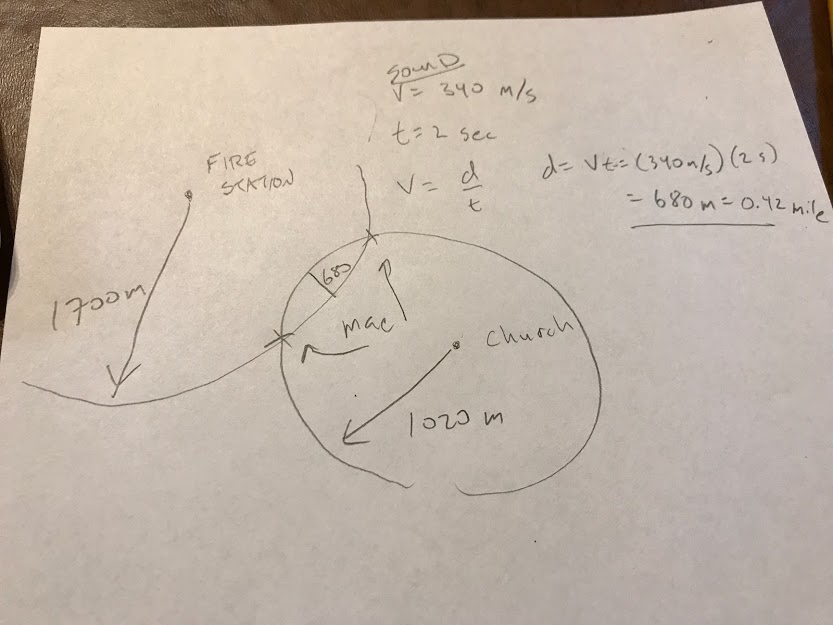
Now for fun, here is my original solution.
Isn’t that fun? Well, it is for me. Oh, what about the two points? You can think of this problem as two expanding circles. Each circle represents a sound and the circle’s radius increases at a rate equal to the speed of sound. So, one circle is going to be bigger than the other one (because that sound was created first). We are looking for the places where the two circles intersect. Yes, there are two of these locations. MacGyver picks the location based on the direction of water flow in the sewer.
You know, I really should make a python animation for this problem. Maybe I will do that soon. Oh, one final note. For my solution above, I recreated the calculation so that it would have the correct values. At the time, I was at my son’s soccer practice. So this is a picture of my notes as they are sitting on the seat of the car. True.
X-Ray Fluorescence
It’s real. The basic idea is to use x-rays on the film. These x-rays excite some of the atoms in the film such that they fluoresce and produce infrared light. You can’t see the IR light, but a video camera can.
It’s something like this—a technique that is used to look at different layers in paintings.












 Rhett Allain's Stuff