MacGyver Season 1 Episode 15 Science Notes: Magnifying Glass

It’s too late to change now—but I wish I had planned better for my titles for these science notes. I just don’t like the way it looks. Oh well. On to the science.

Jumping out of window with a TV cable

MacGyver yanks a TV cable from the wall and ties it around him. Then boom—he’s out of the second story window to catch a bad guy. As he falls, the cable gets pulled from the wall and sort of prevents him from a full force impact with the ground.

Electrostatic dust print lifter

Electrostatic dust print lifters are indeed real. Here is an example of a real one.

The basic idea is to take a conducting sheet and lay it on top of the area where you want to find a print (finger print or shoe print). When a large electric field is applied, the dust literally gets lifted and stuck to the conducting sheet. Boom. There is your print. Oh, you need about 800 volts to get a high enough electric field (according to one paper that is no longer online for some reason).

For the MacGyver version, he uses some mylar for the sheet. In order to create the large electric field, he can use the charging capacitor for the flash in a disposable camera. That might not get up to 800 volts, but it’s a good start. Yes, it’s also true that you can get fairly high voltages just by rubbing two different materials together—as long as the air is dry. This is exactly what happens when you rub your feet across a carpeted floor and then shock the bejeezus out of someone. Same idea.

One more thing. The official version of the electrostatic dust print lifter is pretty expensive. But someone made one for just 50 dollars using a stun gun. Here is the hackaday.com link, but it looks like the original post has link rotted.

Just to show you some more electrostatic stuff—here are some demos that you could try.

Open an envelope with steam from a radiator

Yup, this works.

Wifi wall detector

OK, it doesn’t detect walls. Instead, the wifi can find empty spaces behind walls. MacGyver takes a wifi router with a partially parabolic dish (using aluminum foil) over the antenna. He then connects the output to a speaker (for a cool effect).

Yes, wifi is essentially a radio wave (it is a radio wave). Radio waves mostly pass through walls—but you have wifi in your house and you know that sometimes you don’t get a great signal. This shows that wifi is at least partially blocked by walls. The wifi can also reflect off stuff.

It is this reflected wifi that MacGyver uses to find the hidden room. When there is nothing on the back side of a wall, you don’t get a good reflected signal and that changes the sound of the connected speaker.

OK, this probably wouldn’t work—but it’s still based on this idea that wifi can interact with walls in different ways. Anyway, MIT has created a tool to use wifi to see through walls. Note, this show came out before that. I’m not saying MIT based that wifi thing on this episodes. I’m just sayin.

Movie film roll for distracting fire

MacGyver takes one of those movie film rolls. Adds some stuff and then lights it on fire. When he rolls it down to the front of the movie theater—boom. Distracting explosion. Yeah, lots of stuff burns. No problem here.


Modeling a falling slinky

I already posted some stuff about the MythBusters Jr. slinky defying gravity thing—here are those notes.

But how do you make a model of a falling slinky? Remember, you don’t fully understand something until you model it.

Also, with a model you can quickly test different situations. What happens if you put a car on one end of the slinky (or massive spring). What kind of spring constant do you need? What if the two masses are different?

All of these questions can be investigated with a model.

Let’s get to it. Of course, I am building my model with python—because I like python (and so should you). Here is my code. This is what most of it looks like (sorry, I can’t embed here).


Here is a gif of the output.

Some notes:

  • The balls wait a short time before dropping—just to make it dramatic.
  • I have calculated the position of the bottom mass so that it starts in equilibrium. If you don’t do that, the bottom mass will just oscillate up and down and ruin the whole thing.
  • I added two objects—a stick on the side and a free falling ball. That way you can see how the spring thingy falls.
  • Oh, you should absolutely try changing things up and running the model.

Here is how the model works.

  • There are two masses (the ball1 and ball2)—just ignore the other objects, they don’t matter.
  • Once the top mass is let go, there are two forces on the two balls. The downward gravitational force and then the spring force. Whatever the spring force on the bottom ball is, the top ball has the opposite.
  • The gravitational force is easy to calculate.
  • For the spring force, you need to know the natural length of the spring and the distance between the masses. The spring force depends on the difference between the distance and the natural length—then just multiply by the spring constant. Yes, I often mess up the sign on this force so that the two objects get pushed away in a weird motion.
  • After that, you are pretty much done. Use this force to update the momentum and then use the momentum to update the position.

Homework.

Here are some things for you to try.

  • What if the top mass is 0.1 times the bottom mass? Does this still work?
  • What if the bottom mass is 0.1 times the top mass?
  • See if you can calculate and plot the vertical motion of the center of mass of the two ball system.
  • What if the spring also has mass? There is a way to model this, but I’m going to make you think about it first.
  • Suppose I want to do this with a 2000 kg car. What spring constant would I need? What natural length of a spring should I use?

MacGyver Season 1 Episode 14 Science Notes: Fish Scaler

Isn’t it nice that I have written enough of these MacGyver science note posts that I no longer have to give some witty introductory comment? Oh, I guess that was an intro comment. OK—next time it’s just going to jump into the science.

Picture triangulation

MacGyver is trying to track down some dude. He finds a skyline picture that he drew and assumes the guy drew it from his apartment window (somewhere in Atlanta).

Oh wait! I think I can find out where this guy lives based on the drawing. True? Yes, this is true. If the guy drew a scale drawing, then yes—it’s entirely possible to find out where he drew it from. Oh, if he does an abstract drawing then all bets are off. Right?

There is a lot here, so let me go over two important ideas needed to backwards engineer this drawing.

First—angular size. You already know about angular size. The farther away something gets, the smaller it looks. If you like, you can make it so that someones head appears to be as big as your thumb. Yes, the human would have to be much farther away than your thumb (from your eye).

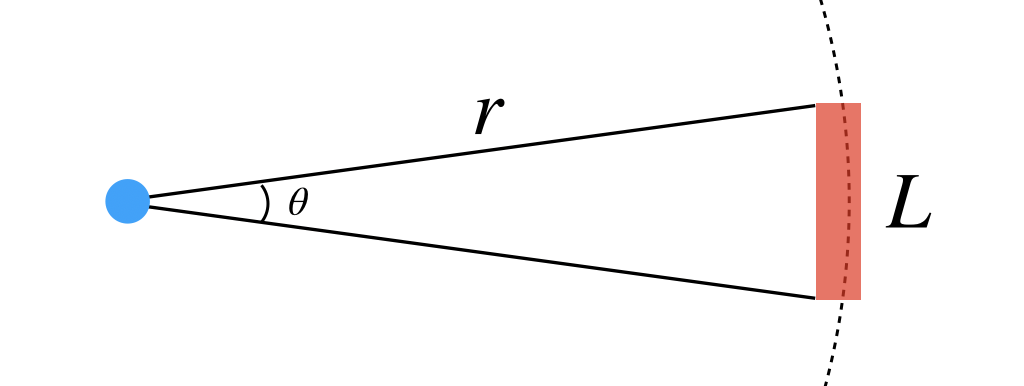
If the thumb covers up someone’s head, then the two objects would have the same angular size. How about a diagram to explain angular size? Suppose some object has a length of L and is a distance r away from an observer. It might look like this.

The blue circle is the observer and the red thing is the object. Yes, I drew it as an arc of a circle. If the object is far enough away, this is very good approximation. That means I can use the arc length equation. Remember that if you go all the way around a circle, then the total length is 2\pi r. That means I get the following:

L = r\theta

Assuming the angle θ is in radians and not degrees. Oh, here is a more detailed explanation of the difference between radians and degrees. But in the end, if you know two of the things (angle, distance, size) you can find the third thing.

If MacGyver sees a building that he is familiar with, he knows the size of that building (or at least he could look it up). But he doesn’t know the distance or the angular size—bummer. If this was an actual photograph, it’s possible he could determine the angular size of the building based on the angular field of view for the camera. However, this is drawing, so the entire width of the picture could be just about anything.

Now for the next idea—triangulation. Suppose you know the angular position of two objects. From those angles, you can draw two lines at those angles. Where those two lines meet—that’s your location.

But you can see the problem, right? The triangulation depends on the angular size of the drawing and so does the distance to the objects. It looks like a dead end. But it’s not. Actually, you have enough information to math-it-out if you try (and boy did I try).

I’ll be honest. I worked on this problem for quite some time. Here is one of my earlier sketches for this calculation.

But yes, it does involve some trig.

Hot wire a car

Everyone wants to steal a car. Honestly, modern cars are fairly difficult to just take. There are four or three (depending on how you count) different classes of cars. Let me list them.

  • Super old cars. These have a key that starts the car. That’s it. You can steal these—BUT YOU SHOULD NOT STEAL CARS.
  • Just plain old cars. These are like super old cars, but they have a steering wheel lock. Sure, you can hot wire these—but you can’t turn the steering wheel.
  • Modern cars. I think it’s cars after 1997. These cars have a chip in the key. No chip, no start. Well, you might be able to start it but the car’s computer won’t pump fuel or something like this.
  • Even more modern. What about those cars with the key fob and you don’t even put the key in the car? You can’t really hot wire those either.

But check it out. This guy has a great video that goes over the different types of cars and how thieves would steal them (but don’t steal cars).

So, in this case MacGyver hot wires a car. It looks like an older model—so it’s at least plausible. What about the steering wheel lock? Maybe he just yanked on the steering wheel really hard and broke the steering wheel lock.

Cleaning bottle bolo

This is pretty straight forward. MacGyver uses a string to tie two bottles of cleaning solution together. He then swings these around and throws them at a baddies legs. The thing is a bolo. It wraps up his legs and he falls like an AT-AT on Hoth (but a lot faster).

Trip wire fan

MacGyver runs a fishing wire in a hallway and then back to the room. The wire then connects to the switch in an electrical fan. When someone steps on the fishing line, it connects the switch inside the fan and turns it on.

This should work.

Bump key

The bump key is a tool used to pick locks. The main goal in lock picking is to move lock pins up out of the lock cylinder so that you can turn the key. Here is a better explanation (I’m not really an expert here).

Light explosion

How do you make a distraction in a parking garage? One way might be to jam a charger for an electric car into a power box for the overhead lights. That’s what MacGyver did.

Would this work? It’s possible. Most car chargers run at 220-240 volts, but most overhead lights are fluorescent lights that expect 120 volts. If you double the voltage, then bad things can happen.

Basically, there is an electrical ballast inside the fluorescent light. This is a transformer that takes the 120 volts and ramps it up much higher (depending on the length of the tube) so that you can make light. If the voltage is too high, the ballast could go boom.

MacGyver Season 3 Episode 14 Science Notes: Father + Bride + Betrayal

Hotel door break in with a coat hanger

MacGyver uses a series of coat hanger wires to build a device that opens a hotel door from the inside. It’s basically a long wire that goes under the door and pulls down on the handle from the inside. Here is a video of what that looks like.

Don’t break into other people’s hotel rooms. That’s illegal. You have been warned.

Oh, but that’s not the best part. MacGyver says this is really about torque. Yes, that’s true. You need to exert a torque on that inside handle to get it to turn.

Wait. The real best part is when Riley says “It means physics is awesome”. Yeah it does.

Thermite toothpaste

So the bad dude that is turning himself in has a special safe. If you try to break in—thermite melts the stuff inside. Yes. Thermite is real and thermite is awesome. In fact, here is an older video where we set off some thermite as a chemistry demo.

We need to do this again.

OK, but could you make thermite into a paste? You might be thinking “oh, if you put the thermite in toothpaste, it won’t get as much oxygen for the reaction.” Good idea—but surprise! Thermite has its own supply of oxygen. You can even get a thermite reaction to work underwater.

Really, the only issue with toothpaste is that you don’t want to get the thermite stuff (particles) too far apart so that they can still interact with nearby particles.

Spray can flame thrower with a bonus

Yes, we pretty much all know that if you get a spray can and shoot it into fire you get a mini flame thrower. Oh, I’ve never done this myself but I know a friend of a friend that did it that one time. I’m sure you’ve never tired this either.

But what about the bonus? If you get any type of fine powder, it also explodes (that’s the powdered sugar part that adds to the flame thrower). Yes, when particles are very small and very spread out—they can explode.

Here is an example from season 1.

Cyanide detection

It turns out that there is a fast method to test for cyanide poisoning (which can happen from certain fires—not just for spies).

Here is an article on how this works— https://phys.org/news/2015-03-cyanide-poisoning-seconds.html.

The basic idea is to get the cyanide the cyanide by mixing the blood with both an acid (muriatic acid and/or vinegar) and a base (like baking soda). Add this to a fluorescent agent like a detergent and then look at it with an ultraviolet light. If it glows—it’s cyanide. At least this is plausible.

Cyanide antidote

For the antidote, MacGyver is basically going to make sulfanegen—an experimental cyanide antidote. Yes, humans do indeed build up a sort of tolerance to cyanide since it’s a natural element in many fruits and stuff. Here is my half-plausible method.

  • You need sulfur. You can get this from match heads. Yes, that’s true.
  • Acid—cleaning supplies.
  • Hydrogen peroxide
  • Blood. Yes—that might be gross, but you do need that.
  • Heat it up and filter it with a coffee filter.

Now, how do you get it to Riley? You could use an IV—but a nasal spray should work too. This is why they give some kids the flu vaccine with a nasal spray.

Don’t actually try to cure someone with this recipe.

Finding the real bad person with interference

MacGyver uses the interference sound from Riley’s radio when she is attacked to figure out that someone is the bad person. Basically, someone had a device that interfered with the radio.

If you had a mobile phone (we didn’t call them smart phones because they weren’t that smart back then) in 90s or early 2000s, then you know what happens when they get near a speaker.

It’s entirely plausible that a medical alert bracelet could do this. In fact, medical equipment often uses older technology because they don’t like to move to newer stuff until it’s been fully tested.

In fact, there could be some type of extra interference caused by the taser and the medical bracelet. That’s what MacGyver wants to reproduce and detect. All he needs to do is to reproduce the taser signal and create an audio output so that he can “test” different people and find the baddie.

Analysis of a borked lab

It happens all the time. It even happens to you. There is a new lab you want to try out—or maybe you are just modifying a previous physics lab. You are trying to make things better. But when the class meets—things fall apart (sometimes literally).

Yes. This is what happened to me this week. And yes—it’s OK.

But let’s look at the lab and go over the problems so that I can make it even better for the future.

Finding the electric field due to a point charge

This is a lab for the algebra-based physics course. It’s always tough because many of the first things they cover in the lecture class don’t have lab activities with things you can measure. Oh sure—there is that electrically charged clear tape lab, but it will be a while before they get to circuits.

So, my idea was to have the students use python to calculate the electric field due to a point charge. This would give them a safe and friendly introduction to python so that we could use it later to get the electric field due to other things (line a dipole or a line charge). It would be great.

Here is the basic structure of the lab (based on this trinket.io stuff that I wrote – https://rhettallain_gmail_com.trinket.io/intro-to-electric-and-magnetic-fields#/introduction/vector-review

You can look at that stuff, but basically I give a workshop style presentation and have the students do the following:

  • Review vectors. Add two vectors on paper (not with python).
  • Find the displacement vector – given the vector for a point, find the vector from that point to another point (the vector r).
  • Find the unit vector and the magnitude of a vector (using python).
  • Next, find the electric field due to a point charge for the simple case with a charge at the origin and the observation point on the x-axis. Do this on paper.
  • Now do the same calculation with python.
  • Find the electric field at some location due to a charge not at the origin (in python).
  • Use python (or whatever) to make a graph of the electric field as a function of distance for a point charge. Graph paper is fine. If they wanted to, they could do the calculations by hand (or use python).
  • Finally, give a quick overview of the sphere() and arrow() object in glowscript.

So, that was the plan.

Lab problems

Here are the problems students had during this lab.

  • Computer problems. Yes—whenever using computers, someone is going to have a problem. In this case, it was partly my fault. There was one computer that was broken and some other ones weren’t updated. Honestly, the best option is for students to bring their own.
  • I can see that there are some students that just sort of “shut down” when they see computer code. They automatically assume it’s too complicated to grok.
  • Students working in big groups. I hate having 4 students use one computer. That’s just lame.
  • Too much lecture. The first time I did this, I spent too much time going over vectors with not enough breaks for students to practice. I partially fixed this for the second section of lab.
  • Some students were just lost on vectors.
  • Yes, the unit vector is a tough concept.
  • I’ve learned this before—but I guess I need to relearn. The visualization (sphere and arrow) are just too much for many students. That’s why I moved it to the end in my second section.

So, that’s it. I am going to rewrite the lab stuff on trinket.io. I am also going to change my material for the dipole stuff that they are doing next week. Hopefully it goes well. Let’s just see.

MacGyver Season 1 Episode 13 Science Notes: Large Blade

Tarp restraint

This is sort of like a straight jacket made out of a tarp and a belt. I wonder how long this would last—but it’s still a classic MacGyver hack. This blog would probably be better if I included pictures. Oh well.

Space blanket as chaff

A space blanket is basically a thin mylar sheet. It has a nice property in that it reflects infrared radiation. The idea is that you cover yourself with this and when your body radiates infrared light, it reflects it back to your body.

Can you use this as a countermeasure against a ground to air missile? Maybe. Of course there are two types of missiles. There is the heat seeking missile and the radar missile. For the heat seeking missile, it is guiding by the giant infrared source—the engine of the aircraft. It’s a least plausible that this space blanket could block the infrared light from the helicopter enough to confuse the missile. Possible.

If the missile is radar guided, then you can block the radar that comes out of the missile. This is the idea behind chaff (a real thing). It’s basically thin strips of metal that fall in the air behind an aircraft. The metal spreads out and can make a large radar reflection such that the missile thinks it’s a target.

Would a space blanket work? It’s possible. Really, you want metal—but this might work at least a little bit.

Splint and crutch from helicopter parts

Classic MacGyver stuff here. Nothing else to say.

Clean water from a tree

Can you get clean water from a tree? It seems like this is legitimate.

Dried wood as a desiccator 

This seems like a plausible way to dry out a wet phone. It would take some time though.

Swiss Army Knife as a signal mirror

MacGyver uses the blade on his knife to attempt to reflect sunlight towards a rescue helicopter. I’m pretty sure this would work.

As a side note—I’ve been thinking about the brightness of light reflected from a mirror (for another project). It seems like this is fairly difficult to calculate. Perhaps the best way is to just experimentally measure the brightness of reflected light. I guess I will do that at some point.

Tree sap and a battery to start a fire

If you want to use a battery to start a fire, you need an electrical conductor. This allows electric current to flow from one terminal of the battery to the other. It’s this electrical current that can make things get hot—hot enough to catch on fire.

So, the battery part is good. What about the tree sap? Yes—apparently, it is indeed a conductor. There you go, a fire.

Distance to lightning strikes

This is another reminder. I should write a post about how to estimate the distance to a storm. The short answer is that when lightning strikes it produces both light and sound. The light has a super high speed, but the sound is just fast (not super high fast). This means that the light gets to the observer first. By counting the time between the “flash” and the “boom” you can estimate the distance.

I thought I had already blogged about this—but I can’t find any such post.

Creating a homemade capacitor to store charge

Here is the short version: MacGyver makes a DIY electrical capacitor (a Leyden jar) to get some electrical charge from a lightning storm. He then uses this to power the satellite phone.

The Leyden jar is totally real. Honestly, I was surprised at how well this worked. Check it out.

Photo Google Photos

Also, I have a much longer blog post over at WIRED.

Finally, you can make something like this yourself.

Zipper as an wire

MacGyver uses the zipper to make a complete circuit from the battery to the sat phone. Would this work? It’s tough to say. In order to get an electric current, you need a closed circuit with a conductor the around the whole path.

Parts of a zipper are clearly conductors (the metal parts). However, if there are gaps between the metal, then it wouldn’t work. If you zip the zipper, there should be contact—at the very least, this is plausible.

MacGyver Season 1 Episode 12 Science Notes: Scissors

Stove Bomb

MacGyver needs a distraction to escape from a cabin in the woods (surrounded by bad guys). He puts some chemicals into an iron stove and rolls it out the door.

The stove explodes when someone shoots inside of it—it’s not because of the spark from a bullet (because they don’t really do that). No, the bullet has to puncture the can of stuff in there to mix the chemicals. That’s what causes the explosion.

Also, a quick note—that stump remover is some bad stuff.

Cheese puffs to get past phone lock screen

How do you find someone’s pin code? MacGyver crushes up some cheese puffs and sprinkles them on a phone screen. The oil from someone’s fingers leave some residue that makes the cheese puff crumbs stick to the phone.

Now you know which numbers are used in the pin code—you still have to figure out the order (and this case it was three numbers so there was one used twice). But MacGyver figures that it’s an important number.

MacGyver Season 1 Episode 11 Science Notes: Scissors

Kill computer stuff with a transformer

How do you get a hacker to do what you want (or tell you want you want)? You start destroying all his electronic stuff. In this case MacGyver uses a transformer to zap some computer equipment.

What is a transformer? It’s basically a coil of wire connected to an AC voltage (like your wall outlet). This AC outlet makes an alternating current in the coil that produces an alternating magnetic field.

Now for the second part of the transformer—another coil. Yes. If you have another coil of wire, the changing magnetic field from the first coil will induce and electric voltage in the second coil. By changing the number of turns in the two coils, you can either increase or decrease the original voltage—or perhaps you could say you “transform” the voltage. Get it?

OK, so MacGyver takes this transformer. With it, he creates a high voltage. The voltage is high enough to make a spark—this is indeed possible.

Next question: how does this spark kill a computer? Well, it’s not the spark but rather the electric current. If you get extra electric current going through the computer stuff, you can destroy those super tiny transistors. They weren’t meant to have much current. Without the transistors, you are pretty much a plain electric toaster.

Scissor Extenders 

MacGyver needs to cut through a cable. It just so happens that this cable is choking someone—so he needs to move quickly. Of course he has scissors on his Swiss Army Knife, but he can’t push hard enough to cut the cable.

This is where the scissor extender comes in. MacGyver gets a long stick and adds it onto the end of the scissor handle. With this long handle, the same pushing force can create a much larger torque on the scissors (torque is the product of force and lever arm). This larger torque is enough to cut through the cable. It’s just like those super long handle sheers that you can use to trim tree branches or those bolt cutters that you can use to cut a chain.

OK, there is one small problem here. One stick might not be that helpful. If you have one long handle and one short handle, then you would have to apply the same torque on the short handle. That would be pretty tough.

Hack a car

This isn’t a “Mac Hack” —but I am going to talk about it anyway. There is a program that can hack into cars and take them over. Sadly, this is partially true. Check out this video from WIRED in which some hackers remotely stop a Jeep. Scary.

Could this be used to take over a nuclear submarine? Well, probably not.

Air Raid Siren

This is classic MacGyver. He creates an air raid siren out of PVC pipe and an AC condenser fan. It would probably work.

I was going to build one of these and make a video, but I didn’t. Here, check this one out instead.

RFID range extender

So, the guys want to use an RFID badge to access a security level in an elevator. MacGyver builds a DIY range extender. This is fairly plausible, but I won’t go over all the details. Instead, I will just share this paper.

Faraday cage

The whole building is a Faraday cage. The basic idea is to create a grounded metal enclosure so that electromagnetic waves can’t penetrate. That means, no phone signals and no wifi outside of the building.

Here is an example of a Faraday cage (from a later episode, but who cares—right?).

Spoof GPS

There is a missile flying towards the USA. That’s bad. MacGyver builds a parabolic dish to act as a GPS spoofer. This could basically work. The signal from the dish could be stronger than the one from orbit and trick the missile into going the wrong way.

Of course, there is one small problem. If the missile is 3000 miles away, you couldn’t get direct-line sight of it unless it was super high. Well, I guess these missiles do go pretty high. Still, it would be hard to aim it.

It’s still plausible.

Artificial snow

How do you make fake snow? One way is to shoot water out of a nozzle at high pressure. When the water leaves the nozzle, it expands and cools off. If it cools off enough, it will freeze and make something that is like snow. These things are real.

But can you make snow above the freezing point? Oh yeah.

MacGyver Season 1 Episode 10 Science Notes: Pliers

Boosting car speed.

Mac and Jack are trying to get away in a car chase (using a not very fast car). Of course MacGyver is going to give them a speed boost, but the first step is to remove the car hood. MacGyver makes some small explosives using chemicals and soda cans. Boom. No more hood.

The second step is to remove the air filter and pour some hydrogen peroxide into the intake. What would this do? This would give the gasoline more oxygen (from the hydrogen peroxide) to produce more combustion. Would this give a speed boost? Probably—at least a little bit.

Chemistry demo – elephant toothpaste.

This is real. Everyone does this—at least all the cool kids do it. You should be cool.

Liquid nitrogen in water

OK, liquid nitrogen is pretty awesome. It’s the same nitrogen that you find in the air, but in liquid form. That makes it very very cold (-196 C). When you add it to room temperature water, the liquid nitrogen boils. In this boiling process it produces a bunch of water vapor—stuff that looks like a cloud.

This was for a different episode, but here is my introduction to liquid nitrogen.

Remote listening device

MacGyver wants to hear what is going on inside a house. The obvious solution is to build a remote listening device. Here’s how it works.

A laser is aimed at a window such that the laser reflects off the window and back to a solar cell. Because people are inside the house speaking, this causes tiny vibrations in the window. The window vibrations vary the intensity of the reflected laser light. When this reflected laser light hits the solar cell, it causes variations in the voltage. Plugging this solar cell into an amplified speaker produces sound. Yes. This is real.

It’s pretty awesome—and you can do something like this yourself. All you need is an amplified speaker and a solar cell (don’t worry about the laser). Connect the solar cell to the audio input and you can hear variations in different light sources.

My favorite trick is to aim a TV remote at the solar cell. You can hear the variations in the IR light that produce different signals to change channels.

Here is a video.

Stop a car with paper

Yup, a version of the banana up the tail pipe from Beverly Hills Cop (great movie). See—everyone is a version of MacGyver at some point.

In this case, MacGyver sticks some paper up the tail pipe of a car. When the exhaust can’t escape, you can’t get internal combustion. Car stops.

Yaghi Antenna

Yes, you can build an antenna out of just about anything—including band instruments. It helps if they conduct electricity. I think this would work.

Technically it’s possible to find the location of a signal with just one antenna (well at least the direction). Just turn the antenna until you get the maximum signal. A better option is to use 2 or more antennas—but you have to work with what you have.

Over inflate tire

Yup. Boom.

Elephant toothpaste version 2

Bigger is better, right? It’s sort of funny.

MythBusters Jr. Slinky Drop Stuff

Tonight’s episode (actually there are two episodes tonight) looks at the famous slinky drop problem. Let’s start with the first place I saw this—from Derek Muller (Veritasium) even though he didn’t invent this either.

That’s pretty awesome, right? Of course the first thing I want to do is to make a model of a falling slinky. Here is that first post.

Some important comments.

  • It’s important that the slinky itself has mass. You can’t use the normal assumption of a massless spring.
  • The best way to model a spring with mass is to have a bunch of smaller masses connected by massless springs.
  • When the slinky is dropped, the center of mass falls with a downward acceleration of -9.8 m/s^2.
  • However, since the slinky is contracting this makes the bottom of the slinky motionless.
Untitled 2

Here is an animation of my python model.

Slinky 3

Sorry—this code is older and I don’t have it on some online platform (I will try to update that soon). But here is the important plot. What if you look at the vertical position of the top, bottom and center of mass for this “slinky”? Here’s what that looks like.

Slinkydrop 2.png

The red curve is the bottom mass. Notice how it “hangs” there? Awesome.

But can you just put a mass (like a car) on the end of a spring and drop it? Yes, but it won’t look very cool. The key is the center of mass. You want the center of mass to fall such that the bottom mass stays in place. With a car and a spring, there is no top mass moving down faster than the acceleration due to gravity to make the bottom mass (the car) move up relative to the center of mass.

In the end, you need some type of mass at the top of the spring too. So, that could work. Two large masses separated by a spring. When you hang and then drop, the bottom mass will be stationary.

But wait! You can try this yourself. Get two masses and connect them with rubber bands (even though rubber bands aren’t ideal springs). Hold one mass and let the other hang below. Now drop.

Here’s what that looks like in slow motion. Sorry about the vertical video, when I recorded this I didn’t think I would post it.

Pretty awesome.

But wait! What if you want to make something like the slinky? In that case you can get a bunch of masses and connect them with rubber bands. It will be just like the python animation above, but in real life.

I should have recorded this in slow motion. Oh well.

Just for fun, here are some of my original notes in which I estimate what kind of spring you would need to do this drop thing with two cars.