MacGyver Season 1 Episode 6 Hacks


Episode 106: Wrench

Using an air bag to break through a bullet proof car window

(physics, explosive, car hack, fairly plausible)

So the heroes are stuck in a car in the water.  The windows won’t roll down.  MacGyver takes an air bag from the car and connects it to the window to blow it out.

Yes, this has a fairly decent chance of working.  Air bags are basically explosives – ok, they are.  There is surely enough explosive power to crack open a window.  However, there is one problem – forces.  As the air bag expands, it pushes in all directions.  If you don’t have it attached to the window, it will just shoot off.  Even in that case there is still a chance it would break the window.

Related: have you seen those crazy videos of people sitting on air bags and then setting them off?  Don’t do that.

Covering a bomb.

(explosive, plausible)

Mac puts a bomb in an upside down dumpster and then pins it with a car.  That has a good chance of helping with the explosion.  Oh, but hot wiring the car isn’t going to be easy.  Most cars made after 1997 have those chips in the key – no more hot wiring.

Smart Phone Camera Extender

(electronic, based on real stuff)

MacGyver takes the camera out of a smart phone and attaches it to a blade so that he can look on the other side of a door (by sliding the camera under the door).  Let’s be honest – there is nothing technically wrong with this hack except for one thing.  There is no way you are going to take apart that phone.  Have you tried taking apart one of these things?  They are glued together and the camera is usually part of the main motherboard.  There is rarely a cable running in there that could be extended.

Diesel fuel dissolving SEMTEX

(chemistry, explosive, plausible)

MacGyver uses diesel fuel to dissolve explosive.  Yeah, this has a good shot of working.  It wouldn’t dissolve right away though.

DIY Pulley System

(physics, mechanical, real)

In order to yank a bolt out of an explosive, MacGyver makes a pulley thingy.  Here is a video with something similar you could build yourself.

The key to a compound pulley is to arrange it such that one string gets pulled further than another string.  This means you can pull with a small force over a long distance to get a large force over a short distance (the key to all simple machines).

Here is a blog post that goes over this in more detail.

MacGyver Season 1 Episode 5 Hacks

You know what would be great for these posts?  Images or gifs of the different hacks from the show.  Maybe someday I can add those.  For now, It’s just science and stuff.

Episode 105: Toothpick

Redirect a heat-seeking missile

(physics, infrared radiation, barely plausible)

I don’t like to use the “barely plausible” tag – but let’s be honest.  It’s going to be pretty difficult to redirect a heat seeking missile.  I guess it’s not impossible though.

A heat-seeking missile has an infrared receiver to look for “hot” objects.  Usually, this hot object is the jet engine exhaust for an aircraft.  So, for this hack, MacGyver wants to get the “attention” of this missile using a flood light.  Yes, these things get hot – but not jet engine hot.

Normally, a plain light would radiate energy in all directions.  Imagine this light as an expanding sphere with a particular radius.  Since the light must be even over the surface of this expanding sphere, the intensity of light decreases with distance.  The area of a sphere is proportional to the square of the radius – so this is where we get the “inverse square law” for light.

Of course the inverse square law means that a bright (and hot) flood light won’t do much if it is far away.  One way to fix this is to use a parabolic dish to refocus the infrared light – a spot light.  Yes, you can do this with a plain metal dish for infrared.

So, in the end MacGyver has an infrared source he can focus on the heat-seeking missile and perhaps get its attention.

Electric Razor Taser

(electric, plausible)

MacGyver makes a type of taser (not really a taser) out of an electric shaver.  The basic idea behind a taser is to shock a person with an electric current.  There are two types of current – there is direct current (DC) like the stuff that comes out of a battery.  This current just goes “one way” in a circuit.  Shocking people with DC current is a little bit more complicated.

The other current is alternating current (AC) in which the current constantly switches directions with some frequency.  In the US, AC current is at a frequency of 60 Hz.  Why does this matter?  It matters because if it’s a plug-in type razor then you already have AC current and it’s easier to shock someone with AC.

So, to make a plug-in razor taser you just need to take the main power lines coming into the razor and connect them to something on the front.  When a human victim touches both of these wires, the human becomes part of the circuit and gets shocked.

Don’t try that at home.

Toothpick gun jam

(mechanical, seems real)

If you don’t clean your gun, it probably won’t work.  A toothpick in the move-y part will probably mess it up.  Not a gun guy.  Oh, I don’t think this would make the gun misfire – just jam.  But you can see where the name of this episode comes from.

Smoke grenades in a jacket

(physical, seems real)

So, MacGyver puts two smoke grenades in a jacket . Really, there’s not much to say here.

Metal Belt Buckle Attack

(physical, real)

In a classic MacGyver move – he uses his belt buckle as a weapon.

Fork Lock

(physical, real)

MacGyver uses a fork to lock a door.  This is a sliding door – but I was thinking of something like this:

Torpedo attack

(explosive, probably real)

MacGyver uses a train torpedo to attack a dude.  Not much to say here.

Thermite

(chemical, based on real thing, plausible)

MacGyver uses a pipe to hold the stuff – magnesium shavings and iron oxide shavings.  Boom – thermite.  Thermite is a chemical reaction that gets SUPER hot.  It’s actually pretty awesome but not easy to make.  You need to get the metal into a very fine powder.  But if you do that, here’s what happens.

Stopping a train

(electric, physics, partially plausible)

How do you stop a train?  One way is to mess with the DC motors.  Yes, most trains are diesel-electric.  They have diesel engines that power electric motors.  If it’s a DC electric motor, you can switch the polarity of the wires and the motor will rotate the opposite way.

This might not stop the train right away – but it’s a start.  Here is a demo you can try at home.  Oh wait – I can’t find the video.  Well, here’s what you do.  Get a battery powered toy car with a motor (a cheap one).  Switch the direction of the batteries and the car will drive backwards.

I found the video.  Here it is.

MacGyver Season 1 Episode 4 Hacks

Let’s keep this going.  Honestly, there might be some mistakes in some of these early episodes.  I need to rewatch all of season 1 – sometimes the script that I work on ends up being slightly different than the final production.  Oh well, the science is still the same.  Right?

Episode 104: Wire Cutter

Network Cable Trap

(plausible, physical hack)

Basically, MacGyver sets up a type of trap powered by a falling server rack that pulls a network cable into a loop to lift a baddie.  It’s just a classic physical hack.

Radioactive Depleted Uranium

(not a hack)

Just a quick note – depleted uranium is used in ammunition and it is indeed radioactive.

Tubular Lock Pick

(physical hack, plausible)

Everyone knows those locks for bikes with the round keys, right?  So apparently, some of these can be “cracked” using the outer case of a plastic pen.

Not sure how many locks this would work on – but clearly it’s possible.

Aerosol Can Explosion

(unlikely, explosion, bullets)

OK, I’m having trouble remembering this one.  MacGyver gets of these mobility scooters (a slow scooter for people that have trouble walking).  He hacks the engine (I think it’s electric) to make it go faster.  Then he puts aerosol cans on the scooter so that one of them sprays stuff at the other.  When a bullet hits a can, the whole thing explodes.

The problem: bullets don’t really make sparks.  I’m pretty sure the MythBusters tested this – but I can’t find the episode right now.

If you DO make sparks, then yes – the stuff will explode (ish).

Note about Russian computers

There was a bunch of discussion on this episode about how to hack a 1960s era Russian computer.  What would it look like? What would the programming language be?  How would you hack it?  Tough stuff.  Maybe I will save this discussion for a future post (remind me later).

Computer AC-DC Converter

(Real, computer, electricity)

Electricity from the wall is AC (alternating current).  Your computer runs on DC (direct current).  In this hack, MacGyver takes a DC battery from a laptop and uses it in a computer.  This would basically work.  The only problem is power – some of those old computers were hogs.

Flour Explosion

(real, explosion, chemistry)

Flour is indeed explosive. If you get it in the air, then each “flour particle” (not really particles) has a large surface area to mass ratio and can burn super fast.  Burns so fast it explodes.

You can do this at home.  It’s only slightly dangerous.

Hook and Barrel

(physical, plausible)

MacGyver hooks a cable to a barrel and the other end to a mechanic creeper.  When he pushes the barrel down some stairs, it pulls the creeper.  Classic.

Belt Ring Belay Thingy

(plausible, physical)

The ring on a belt is used to run a rope through to act as a brake.  This would probably work.

Improvised Keyboard

(plausible, computer, electricity)

It depends on what kind of computer keyboard this would be – but keys are pretty simple things.  It’s possible to make a key out of some everyday items and connect it to a broken keyboard.  Of course, this would take a bit longer than you would expect to get it to work.

Fixing Stuff Isn’t So Bad

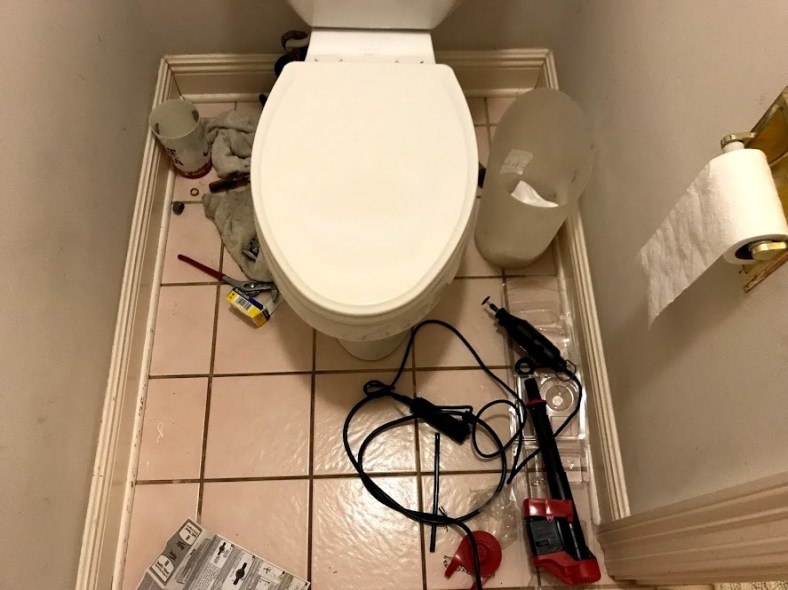
Today it started with a lose bolt that holds down the toilet.  Actually, the bolt was gone – beyond gone.  Rusted away.  I figured the flange thing that the bolts go into was probably busted too, but you can’t tell until you lift up the whole toilet.

When starting a project like this, I always go to youtube first.  What a lucky time to live in that we have a resource like this.  Of course it wasn’t just the broken bolt.  I needed to replace the wax seal too.  As long as I’m working on the toilet, I should also replace that tank fill valve that was slightly leaking.

Oh wait! When I turn off the water to the toilet with the shutoff valve, that is leaking too!  After a trip to the hardware store and multiple rounds of turning off the water to the whole house, I finished the job.  The seat doesn’t rock, the shutoff valve doesn’t leak, and the fill valve stops when fill.  Oh, how about a quick advertisement for those quarter-turn shutoff valves?  My house has these “multi-turn” valves that are like the kind on your outdoor water hose.  I’ve already had two of these leak – so that’s not so good.  Also, when the toilet overflows (it happens), the quarter turn is faster to shut off.


IMG_5448

Photo: Rhett Allain

I’m just going to say one other thing about toilets (this is not a toilet post).  It seems like a pretty simple job – but once you get confined in space, everything gets just a little bit more complicated.

OK, but in the end – it’s finished.  In the end, I’m pretty happy.  I feel like I accomplished something.  I fixed something and made it better.  I feel human.

I wasn’t always like this.  I remember in my early adult years I would think:

Why can’t they just make toilets that don’t break?  For that matter, why not make a lawn that doesn’t need mowing.  Oh, how about clothes that don’t need washing?  All of this cleaning an fixing stuff is just taking away time from more important stuff.

That was the old me.  The new me doesn’t mind these chose so much.  Oh, I still get bothered sometimes.  When the lawn needs mowing and it’s super hot (or won’t stop raining) or when something breaks and you JUST KEEP MESSING UP.  Yes, those times are frustrating.

But I’ve come to accept that we live in a world that increases in entropy.  If you leave stuff alone, it will just mess up and eventually break.  What makes humans so awesome is that we can fight this tide of increasing disorder.  We fix things.  We clean things.  We are humans.


Summer at CERN

I like telling old stories – so I am just going to keep doing that.

I wanted to share a particular story of an event while I was at CERN – but then I figured I should explain why I was at CERN first.  So, here it goes.

I was an undergraduate student at Benedictine University (we called it I.B.C. back then) with a major in physics.  BTW – that was a great experience, I should write about it sometime.  After graduating, really the only graduate program I was accepted into was at The University of Alabama (in 1992).

After my first year, I started working with the Experimental High Energy Research group.  I honestly have no reason to be in this field except that one of the physics faculty sort of invited me into the program – so I did.  I clearly wasn’t theoretical physics material – so, what the heck.  I figured that’s where I would go.

The group originally worked with the Superconducting Super Collider (SSC).  This was a giant particle accelerator being built in Texas.  SPOILER ALERT: they soon canceled the program.  Anyway, our group’s role was to build muon detectors.  These are essentially super long Geiger tubes.  In order to get precise muon track position, we needed a precise location of the wire in the middle of the tube.  Since these were long tubes – the wire had a sag.  It was that sag that we tried to determine.

But the SSC was canceled.  I think the program had some funds left over from the grant – so the faculty member in charge decided to collaborate with CERN.  He had money to send me there to work the following summer.  I think his main goal was to use up the money and have a student listed as “doing research” – that would look good for his tenure application.  Yes, faculty do silly things like this.

I didn’t really want to go to Switzerland.  I know people travel to all sorts of crazy places when they were much younger than me, but I really didn’t do stuff like that.  On top of that, I really didn’t know what my “mission” was at CERN other than to serve as a “checkbox” on a physics faculty tenure application.  Oh well – I went anyway.

Wait.  What the heck is CERN?  CERN (European Organization for Nuclear Research – the acronym works in French)  is in Geneva Switzerland (mostly) and is a particle accelerator.  So, essentially it is a giant underground ring that accelerates particles and then smashes them into other particles.  There are some particle detectors spaced around the ring to – you know – detect stuff.  Our group worked on the L3 detector.

OK, so I move out to Switzerland for the summer.  Maybe now would be a good time to point out that that part of Switzerland speaks French.  I don’t speak French.  However – I am fluent in pointing at stuff.  Most people at the research facility spoke English – but food was in French.  I just pointed.  I didn’t starve to death.

While I was there, my “job” (which was poorly defined at first) was to write and modify FORTRAN code to analyze detector alignment data.  Basically, there are more than one detectors and you need to know the relative position of these things to track particles.  We had two alignment systems – a laser alignment and a capacitive sensor.  I was supposed to take data from these and then “do stuff”.

I’m a pretty sucky FORTRAN programmer.  I was then, and I still am now.  It was great to be at CERN, but I mostly just worked in the computer lab messing things up.  I really don’t know if I even accomplished one thing while I was there (research-wise).

I did get to meet lots of new people and hang around CERN and see cool stuff.  Overall, it was a great experience.

More on my CERN adventures will be posted at some point.

I hate FORTRAN.

A Quick Note: Packing for College

My oldest daughter is currently in the process of getting her stuff together.  She is moving away for her first year of college.  Hope everything goes well, but I keep thinking of this scene from The Hobbit.

Yes, in college you will have to do without a great many things.  Honestly, that is part of what makes the whole college experience so great.  It’s not just about classes, but all the things in between (if it was just about classes – it would make more sense to stay home and take classes online).

No, you won’t have everything perfect in college (or in life really).  You won’t have the best shoes for a particular event.  You might have to wear the same pants more than once.  You are going to have to share a room with someone – and a shower too.

But you know what?  It’s not just college – real life is like that also.  It’s not about making everything perfect, it’s about living with what you have.  You can never have a perfect life – unless you learn to enjoy the imperfections that life throws at you.


MacGyver Season 1 Episode 3 Hacks

Welcome to my continuing series on the science behind MacGyver hacks.  Really, I should start changing the blog title so that it includes the episode name – this one is titled: Awl.

Another note: I was going to wait until the MacGyver Season 1+2 DVD came out so that I could rewatch each episode.  I don’t want to wait, so I am just going from my original notes for this episode.  Let’s get started.

Episode 103 Awl

Body bag with fire extinguisher for jumping out a window

(slightly plausible, physics, forces)

MacGyver and Jack need to escape a burning building.  They grab body bags with fire extinguishers and then jump out of a 3 story building.  On the way down, they inflate the body bags with the extinguisher to make a cushion to land on.  That’s the hack.

Actually, I already wrote a whole blog post on this hack – here it is at wired.com. But the short answer that this is based on some real stuff.  Increasing the distance over which a human stops decreases the acceleration.  Smaller accelerations are better than higher accelerations.  Oh, filling up the body bag on the way down is the best so that the CO2 won’t have time to escape.

Still, I wouldn’t try this at home.

WiFi Jammer

(very plausible, light, electronics)

MacGyver uses one of Riley’s wireless cameras to make a wifi jammer.  There are two important parts to this hack.  First, he needs to do something to the camera so that it sends out some type of signal to “jam” other wifi.  He uses a cigarette lighter to solder wires.  I’m not sure that this would work – but it’s at least plausible.

The next part is to add a directional antenna to the wifi camera so that the signal can be sent to the house (that needs to be jammed).  MacGyver builds a directional antenna to add over the existing antenna using a soda can.  This is real.

In fact – you can build this yourself, here is how.

Thermal Camera Note

(maybe, light, infrared)

This isn’t really a hack – but there is some science.  The team uses a thermal camera to watch the dude they are spying on enter his pin code.  The keys he pressed stay warm and they use this to figure out his alarm code.  This part is real – in fact, there was a story about people using thermal cameras to steal pin codes.

Now, there are two possible problems in this “hack”.  First is the glass.  Actually, I can’t recall how it happens in the show – but I advised to be sure to look through an open window.  Infrared light doesn’t go through glass.  Even though infrared is still a type of electromagnetic wave (just like visible light), it interacts differently with matter.  It doesn’t go through glass, but it CAN go through some plastic – here is more details.

The other issue is resolution.  Infrared has a longer wavelength than visible light.  This means that it’s more difficult (but not impossible) to see small details from far away.

Bullet Vent Seal

(plausible, biology, medical)

A guy has a bullet wound.  MacGyver uses a drivers license and tape to make a flap.  This flap allows gas to escape – but not other stuff in.  That’s all I have to say about that.

Headrest Smoke Bomb

(plausible, fire)

Mac stuffs some paper into a car’s headrest and lights it on fire.  It makes smoke to act as a smoke screen.  It probably wouldn’t work very well – but it would make some smoke.

Hot antifreeze disinfectant

(slightly plausible, medical)

If you want to do some medical stuff in the back seat – you need a clean environment (or the patient will die from infection).  In this case, MacGyver uses hot radiator fluid to wipe down the area.  Hot stuff usually kills bacteria – but this probably wouldn’t work.

Windshield wiper pump for gross stuff

(plausible, medical, electrical)

MacGyver basically uses the windshield wiper pump to suck stuff out of the guy’s lungs.  I don’t want to talk about this.

Improvised syringe

(plausible, mechanical build)

This is just putting stuff together.

Soda bottle gas mask

(plausible, mechanical build)

Cutting a soda bottle (plastic) so that it fits on your face is pretty straight forward.  Filtering out stuff is harder.  In this case, the filter is just wet newspaper.  This would filter out some stuff – but just smoke and dust and things.

Refrigerant gas attack

(it’s a stretch, chemical)

Mac uses refrigerant as a gas attack – not so sure about this one.  It’s clearly bad to breath in – but it would probably take quite a bit in a small space to knock someone out.

A Cave Diving Story

I want to write about some things that happened in the past – mostly so I don’t forget.  In this case, I’m going to describe a particular cave dive that sticks in my mind.  Now, there is a warning.  This might not be exactly what happened – but it might also be true.  It’s probably the way it happened.  Let’s begin.

In case you aren’t familiar with cave diving, the main idea is to explore a cave that is completely underwater.  You start outside the cave and you are already underwater. This is not spelunking – this is cave diving.  We mostly went into springs in the panhandle of Florida – that was our roaming territory.

Just for fun, here is a picture of me with my cave diving gear.

Please don’t complain about the setup.  This was a picture from my cave diving class.  I learned quite a bit after this and changed things up – but still you can get an idea of what it was like.  That was my friend’s van that we used to drive to different caves – it was pretty sweet.

Ok – now for this one particular dive.  I am pretty sure this was at Twin Cave.  Twin Cave is in the middle of Merritt’s Mill Pond in Marianna Florida.  The only feasible way to get here is with a boat (unlike most cave diving in which you just walk into the water). It’s called “Twin Cave” because it has two entrances right next to each other (underwater).  If you have a boat, you can use a tiny little wood platform connected to two trees to set up stuff.

My dive partner (Trey) and I hitched a ride with Pat Watson.  He had a little john-boat and ferried us to the cave.  He then went back and picked up two more divers – Pat was teaching them how to cave dive and this was one of their “check out dives”.  Oh, I should add that at one point there was so much stuff in that little boat that it was barely above water.  One tiny wave and I think the thing would sink.

Now for the dive plan.  Go into Twin Caves and get into the lower levels.  In this case, we would use diver propulsion vehicles (DPV) to get through the easy part and then proceed in the lower part by swimming.  The DPVs are awesome (also called scooters).  That’s the truth.  I always wanted a scooter – but I never got one.  Fortunately, my dive buddy had just recently upgraded his DPV for a bigger one.  That meant that he still had his old one.  BOOM – scooter time,

You’ve seen these scooters.  They are basically small torpedo looking things (not exactly) with an electric motor.  You connect a line from the scooter to you so that you can “drive” with one hand.  That’s not really important, but I just wanted to say that.

Ok, so we start off on our dive.  I seem to recall that it’s sort of tricky getting into Twin Cave.  The main entrance is a vertical shaft – but then you have to turn horizontal right when you get in.  If you don’t turn correctly, you hit the the bottom of the cave.  Most cave bottoms have this silt stuff – if you hit it you change the cave water from pristine clear water to brown soup that you can’t see through.  So – don’t hit the bottom (this will be important later.  Oh, it’s even harder to get in this cave when you are trying to do with with a scooter.  We probably had a stage bottle too.

I guess I should say something about stage bottles – for completeness.  A stage bottle is an extra scuba tank that you mount on your side.  You use this stage bottle for the first part of the dive – until it gets 2/3 full.  At that point, you take the tank off and leave it on the line (there is a line running in the cave).  You then proceed on the dive using the two tanks on your back.  Using stage bottles lets you go much farther than just with double tanks.

Now back to the dive.  The first part of the cave is pretty cool.  It’s this big cylindrical cave that we called the subway.  Ok, that might not be true.  In my mind, we called it the subway.  It was super easy to get through with a scooter – just imagine a long straight circular tunnel with a diameter of about 3 to 4 meters (let’s say 10 feet for imperials).  Like I said, this is perfect for scooters.

At some point, we moved down to some small stuff and dropped off the scooters.  There are two important points here.  First, this part was deeper (can’t remember the exact depth) such that we will have more decompression time.  Second, it was low and slow down here – longer time at depth also means more deco.  I’m not going to really talk about deco time right now – but let’s just say that you don’t want to rack up a ton of deco time – it sort of sucks.

So we did our exploration of the lower part.  Now it’s time to get the hell back to the entrance and do our deco.  No more sight seeing – just hurry up.  We pick up our stage bottles and our scooters and scoot out.  Oh, quick note.  There are two things that are awesome to see in a cave.  The first is the warm glow of the Sun when you are near the cave entrance – this tells you that you are almost out.  The second is your stage bottle.  Picking up a stage just says “hey, you just got a bunch more air and a completely independent air supply – you have less chance of dying now”.  It’s awesome.

Now for the whole point of this story.  We are there on our scooters moving out of the cave while back in the subway.  Ahead we see some lights.  It was Pat and his two students.  As we start to get near, something happens.  The inflator on Pat’s buoyancy compensator (BC) just falls off for no apparent reason.  In case you have never been diving, the BC is basically a bag of air that you can fill up or empty to adjust how you float in the water.  It’s super important in cave diving because you want to stay off the bottom of the cave where all that silt is (remember I mentioned this before).

When Pat’s BC failed, so did his ability to stay off the bottom of the cave.  It was weird – he just took a dive straight down.  He sort of looked like a B-17 bomber that had just been shot out of the sky.  I saw him try to make a correction to his buoyancy, but it wasn’t going to happen.  He ended up just putting two fingers straight down to catch his fall (this is what we were taught so as to minimize the silt disturbance).  It didn’t work. His crash produced silt.  A lot of silt.

It was really amazing.  This clear water subway tunnel suddenly turned into a tunnel with a wall.  A wall of silt.  You really can’t see much in this silt – it’s effectively zero visibility (but not as bad as clay in the water).

Since we were traveling along at a good pace with the scooters – it only made sense to slow down quite a bit.  I knew there were three divers inside that wall of silt, but I didn’t know WHERE exactly they were.  So I slowed down.  Gradually clicking the throttle trigger on the scooter to maintain a slow crawl speed.

To my surprise, my dive buddy chose a different strategy – he decided to just keep going at his current speed.  I saw him head straight into that wall of silt – waiting for some type of collision.  But no, he made it though.  It was a bold move and it paid off.

For me, I went through slowly and made it to the other side of the silt wall (which wasn’t very thick).  After that we did our deco and finished the dive.  I sort of recall not taking the boat back to the van and staging area.  Instead, we used the scooters the rest of the way.  It didn’t matter at that point – you don’t have to worry about saving scooter battery or scuba air.

The end.
Astronomy and Space Posts

Here are some posts for you.